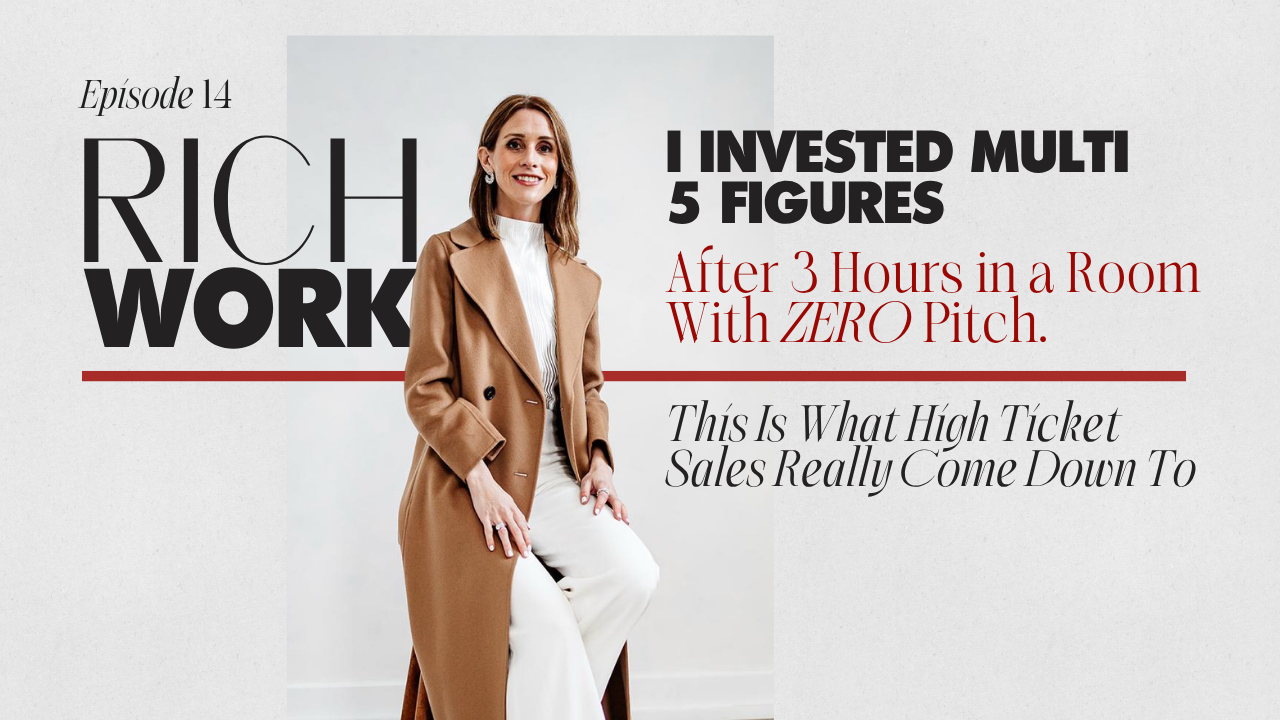
I Invested Multi 5 Figures After 3 Hours in a Room With ZERO Pitch. This Is What High Ticket Sales Really Come Down To [ep. #14]
LISTEN ON:
Most people think high ticket sales come down to having the perfect pitch. The right framework. A methodology so impressive that buyers can't say no. And I get it because the online space has been telling you that for years.
→ Get your sales script right.
→ Nail your objection handling.
→ Build a funnel that does the heavy lifting.
But here's what I know from sitting on the other side of the table. I am the high ticket buyer. I have invested multi 5 figures into a single person's offer after spending 3 hours in a room with them. And they never once pitched me.
Not once.
The decision was made before I ever looked at the details of what I was buying. Before I saw the price. Before I understood the full scope of the offer. I already knew I was in.
So if I didn't buy because of a framework or a pitch or a perfectly worded proposal, what made me hand over multi 5 figures to someone I had never met in person before that evening?
That question is something I think about a lot. Because if you are someone who sells at a premium level and you are trying to attract clients who invest at that level, you need to understand what is actually going on in the buyer's mind. And most of the advice out there gets it completely wrong.
I'm going to walk you through exactly what happened that night in London. What she did differently. What most people miss when they sell at a premium level. And why your sales strategy might be the very thing pushing your dream clients away.
The Mistake Most People Make When Selling High Ticket Offers
When most people try to sell a premium offer, they lead with the method. They want to tell you about their unique framework. The 5 step process. The proprietary system they built. They think that if they can just explain the methodology well enough, buyers will see the value and invest.
I see this constantly. Sales pages packed with curriculum breakdowns. Pitch decks that walk you through every module. DMs that open with "let me tell you about my process."
And it makes sense on the surface. You've built something you're proud of. You want people to understand why it works. But the problem is that when you are selling at a premium level, the method is not what closes the sale.
I have never once invested multi 5 figures because someone's framework sounded good on paper. What I invested in was the person. The certainty they carried. The way they showed up. The experience of being in their world before any transaction ever took place.
Think about it this way. If someone invites you to a beautifully curated dinner in London with 7 people at the table, journalists in the room, and an intimate format that you've never experienced before, that tells you something about who they are. The environment they create communicates their standards before they ever open their mouth about what they sell.
Now compare that to someone who sends you a DM with a bullet pointed list of what their programme includes.
Both are trying to make high ticket sales. Only one of them is creating the conditions for a high ticket buyer like me to say yes.
Your method matters. Of course it does. But if you are leading with it, you are skipping the part that makes high ticket clients want to invest. You are skipping the part where they decide they trust you. And trust is not built through a curriculum overview.
High Ticket Sales Happen Before the Conversation Starts
This is the part that most people miss entirely. By the time someone gets on a sales call with you, the sale has either already happened or it hasn't. The call is not where the magic is. The call is just confirmation of a decision that was already forming long before you spoke.
Every touchpoint someone has with you before that conversation is doing the selling. Your content. Your events. The way you communicate. The people you surround yourself with. The standards you hold. The experience of being in your orbit. All of it.
When I walked into that room in London, I didn't know I was about to make a multi 5 figure investment. But the moment I sat down, something shifted. The calibre of the room. The way the evening was structured. The intimacy of 7 people at a table rather than 70 in an auditorium. Every single detail had been thought through. And none of it was about selling me anything.
That is what a real sales strategy looks like at the premium level. It's not about what you say on the call. It's about every single decision you make before the call ever happens.
If you are trying to attract clients at a high ticket level, stop obsessing over your pitch and start looking at the full experience of what it's like to encounter you and your brand. What does it feel like to be in your world? What do your spaces communicate about your standards? What is the experience of being around you before money is ever discussed?
Because that is where high ticket sales are won or lost. Not on the call. Not in the DM. Not on the sales page. In everything that comes before it.
The 3 Hour Dinner That Led to a Multi 5 Figure Investment With Zero Pitch
Let me tell you exactly what happened that evening in London. I walked into a room with 7 people at a dinner table and a woman I had never met in person. It was a PR dinner with a format I hadn't seen before (one that people are already copying). We sat with journalists, asking questions, and understanding what they're really looking for.
The woman who hosted it never pitched me. She didn't mention her offer. She didn't slide into conversation about what she could do for me. She didn't engineer a moment where the topic conveniently landed on her services. She simply hosted an extraordinary evening and let the room do the talking.
And the room said everything.
→ It said "this person operates at a level of excellence that most people don't."
→ It said "this person curates spaces that are intimate, intentional, and valuable."
→ It said "this person's standards are so high that being in this room with these people on this evening is already an experience worth paying for."
That is a high ticket sales strategy in its purest form. She didn't need to tell me she was good. The entire evening proved it without a single word about her offer.
Within weeks, I had invested multi 5 figures to work 1:1 with her for 12 months. And I made that decision before I had even seen the full details of the offer. I didn't need to see them. I already had everything I needed to know from 3 hours at a dinner table.
This is what I mean when I say your sales strategy needs to start long before the pitch. If you are waiting until the sales conversation to start selling, you are already behind. The buyer's mind is forming opinions about you from the very first touchpoint. And if that first touchpoint is a cold DM with a list of what your programme includes, you've already lost someone like me.
The woman at that dinner understood something that most people who sell at a premium level don't. She understood that high ticket sales are not about convincing someone to buy. They are about creating an environment where the buyer convinces themselves.
Why Using AI in Sales Without a Human First Approach Is Losing You Clients
I need to talk about this because it's something I'm seeing more and more. People are using AI in sales to write their pitches, their proposals, their DMs, their follow ups. And I am all for AI. I use it in my business. I think it's an incredible tool.
But I received an AI generated pitch recently and I knew within seconds it wasn't written by a human. Not because of the grammar. Because the pain points it listed were completely wrong. Not a single one of them was actually mine. And that's because nobody had asked me a single question before sending it.
They used AI to sound credible and instead it exposed how little research they had actually done. They listed problems I don't have. They assumed challenges that aren't relevant to where I am in my business. And the whole thing felt like a template that had been sent to 50 other people.
If you want to use AI in sales, go for it. But it has to be human first. AI should support the process, not replace the part that actually builds trust. Because when I receive a pitch that feels like a template, I don't just ignore it. I actively decide that this person doesn't understand me well enough to work with me. And that is a hard impression to undo.
The people who are making high ticket sales right now are the ones who use AI to support their process but lead with genuine human connection. They do the research. They ask questions first. They understand who they're talking to before they ever make an offer. AI handles the admin. The human handles the relationship.
If you are using AI in sales and wondering why your conversion rate is dropping, this might be why. You've optimised for speed and sacrificed the one thing that high ticket clients actually need. Trust.
How to Attract Clients Who Are Ready to Invest at a Premium Level
So what does all of this actually mean for how you show up and sell?
It means that if you want to attract clients who are ready to invest at a premium level, you need to stop thinking about selling as something that happens in a single conversation and start thinking about it as an experience that begins the moment someone encounters you.
Your content is part of your sales strategy. Your events are part of your sales strategy. The way you respond to DMs, the spaces you create, the people you associate with, the standards you hold publicly. All of it is communicating something to the person who is watching and deciding whether or not you are someone they want to invest in.
I knew I wanted to work with the woman from that dinner before she ever mentioned what she sold. Because every single thing about the experience she created told me who she was and what it would be like to be in her world.
That is how you attract clients at a premium level. Not by pitching harder. Not by optimising your sales script. Not by using AI to send more messages to more people faster. But by creating an experience that makes the right person feel certain about you before you ever ask them for anything.
High ticket sales are not about volume. They're not about automation. They're not about having the cleverest framework. They are about the human experience you create around your brand and your offers. Get that right and the sales take care of themselves.
Key Takeaways
• High ticket sales are won or lost before the pitch ever happens. Every touchpoint a buyer has with you is part of the selling process whether you realise it or not.
• Leading with your framework or methodology isn't enough to attract clients at a premium level. Buyers invest in the person and the certainty they feel, not the curriculum.
• If you are using AI in sales, it must be human first. AI generated pitches that skip the research and personalisation are actively pushing high ticket clients away.
• Your sales strategy should be an experience that starts the moment someone enters your world, not a script you deliver on a call.
FAQ
What are high ticket sales?
High ticket sales refer to selling premium offers. These sales usually involve a longer decision making process because the investment is significant. Buyers at this level aren't impulse purchasing. They need to feel a high level of trust, certainty, and alignment with the person or brand before they commit. High ticket sales require a different approach than lower priced offers because the buyer's expectations around experience, personalisation, and relationship are much higher.
What are the biggest mistakes in high ticket sales?
The biggest mistakes in high ticket sales include leading with your methodology instead of building trust first, relying on a single sales conversation to do all the heavy lifting, sending generic or AI generated pitches without personalisation, and focusing on volume over quality of experience. Another common mistake is not recognising that high ticket sales start long before the sales call. If the only place you're "selling" is on the call or in the DM, you're missing all the touchpoints where your buyer is already forming their opinion about whether or not to invest.
What is the best sales strategy for attracting high ticket clients?
The best sales strategy for attracting high ticket clients is to focus on the full experience someone has with your brand before any sales conversation takes place. This means your content, your events, your spaces, and your communication should all reflect the standards and quality of your premium offer. High ticket clients make their decision long before the pitch. They're watching how you show up, who you associate with, and what it feels like to be in your world. Focus on creating certainty and trust through every touchpoint rather than relying on a single sales call to close the deal.
How can you use AI in sales without losing the personal touch?
The key to using AI in sales without losing the personal touch is to treat AI as a support tool, not a replacement for human connection. Use AI to help with admin, research, drafting, and organising your process. But never skip the step of personally understanding who you're selling to. The biggest mistake people make is sending AI generated pitches without doing any research on the person first. Lead with genuine curiosity, ask questions, and personalise every interaction. Let AI handle the backend while you handle the relationship.
CONNECT WITH RACHEL:
Resources mentioned in this episode:
The Debrief Telegram group: https://rachelpearson.kartra.com/page/debrief
Mastermind event on 12th June in Central London: https://rachelpearson.kartra.com/checkout/dcee34f07e0cc55b1ff89db4c2f32573
Download your episode freebies: https://rachelpearson.kartra.com/page/sJM184
More about Rich Work:
Welcome to Rich Work, the podcast for Welcome to Rich Work, the podcast for established women entrepreneurs who know they should be charging more, but haven't cracked the code on premium positioning yet.
I'm Rachel Pearson, a Global Brand & Business Strategist who spent 15 years building luxury brands like De Beers and launching an airline during a pandemic. Now I help women scale to consistent 5 and multi-6 figure months without the constant proving or over-delivering.
Every week, I break down how luxury brands create desire (think: Chanel, Hermès) and how to apply those principles to your business. You'll get premium positioning strategy, high-ticket business moves, and the identity shifts that actually let you hold the wealth you're building.
This is for women ready to attract clients who pay in full, build the life (the retreats, the calm mornings, the legacy work), and stop following someone else's playbook.
If you're done playing small, you're in the right place. Connect with me on Instagram @rachelpearson.co. Ready to rewrite the rules?
Transcript
[00:00:00] Last night, I went for dinner in London with somebody who I met in Dubai at the end of 2025. When we met in Dubai, it was the first time that we'd ever spoken, and we were introduced by a mutual connection.
How a Dinner in London Turned Into a Business Opportunity
[00:00:15] She lives in the States, obviously I live in the UK, and 6 months later, she got in touch, said, "I'm in London. Let's go for dinner." And we had the best conversation around what is changing in the industry. She's also a female entrepreneur, very successful. We talked about what is coming next. We talked about life, business, and potential collaboration between both of us.
[00:00:38] We talked around things that we want to change in the industry and how we could do that together. It was a really beautiful conversation, and it's interesting timing because I'd already planned to do this podcast episode around what is it that means you can have a conversation with somebody who you've not met before.
[00:00:56] This is what happened to me in Dubai last year. And then that conversation could potentially turn into a business opportunity, a collaboration. It can turn into a new client. It leads into something, right? It's not just a conversation where it was nice to meet you, great, let's move on with our lives. This happens to me a lot.
[00:01:19] I am really good at nurturing relationships, and I'm not going into this episode about how I've built my network. That is a whole separate episode, and if you want to get into that right now, this is something I have covered inside the Debrief, which is my free Telegram space. You can go into the link in the show notes.
[00:01:36] You can join that for free. But this episode is not about how to build that network. There is an approach to creating certainty in conversations with potential clients, in conversations with potential collaborators, in any room that you go into. Creating that certainty about who you are and the potential that somebody else sees in you is not by chance.
[00:02:02] And that is what we're going into in this episode. When you are focused on high-ticket sales, and by selling I don't just mean selling your offers or your services, I mean creating these opportunities where it could lead into something amazing that you haven't even considered, like going onto a TV show, being featured in the press, or being introduced to somebody who's going to really move your business forward.
[00:02:27] That is all sales to me, right? It's not like selling myself to that person, but I am positioning myself so that they understand who I am and why they would want to talk about me, why they would introduce me, why they would want to think of me for future opportunities. That's what sales is to me as well. And it comes down to one thing, which I know is talked about a lot in the online space, and that is certainty.
[00:02:48] Certainty is conviction in who you are. It is a feeling. It is a way of speaking about yourself. But in this episode, I'm going to explain what that means, what that looks like when you are talking about your services, when you are selling to a potential client.
[00:03:17] And stay with me till the end because I am sharing something that is directly related to this. If you are in London, then you will definitely want to know about it. And if you're not, then stay till the end for the show notes because there are prompts that are going to help you go through this process yourself.
Why Certainty Is the Foundation of High-Ticket Sales
I want to start with a question. When did you last sign up to something yourself that was a stretch, a significant investment, or felt a level of discomfort for you because it was taking you into a new area? A high-ticket programme maybe, a premium service, a big investment?
[00:03:48] And the caveat here is you have to feel certainty. Before you even went into it, before you even started, you had to feel certainty about making that investment, making that decision. Not talked into it, not convinced by the sales page, just certainty in your body. No question that this was the thing you were going to do.
The Last Time I Made a Multi Five Figure Investment
[00:04:14] The last time that this happened for me was almost a year ago, which kind of tells you a bit about the way that the industry is right now, because I am a big investor in the online space. But the last time this happened for me was that I went to an in-person event, and it was a very small room.
[00:04:33] I think there were about 7 of us. It was a PR event, an evening event, with somebody who I didn't know. I'd heard of her. We'd had a few DMs back and forward about this event, which I think at the price point was around £400. I went to this room. It was an evening dinner. It was a new format where she brought journalists into the room.
[00:04:57] We got to have dinner with them, ask questions, start a conversation, and understand what they're looking for. It was a different format that I hadn't seen. And so I saw that was a risk for her to do, right? It was a risk for her to go out and try that format. And following that event, I then decided to work with her one-to-one, and that was a 12-month commitment, multi 5 figures.
[00:05:22] So I went to an event of somebody I didn't know personally. I spent £400 to be in that room, and I then very quickly invested multi 5 figures. I did my due diligence of looking at the offer and understanding what it included, but I'd already made my decision before I looked at that.
[00:05:45] I am the high-ticket buyer that if you're listening to this podcast, I am probably your ideal client. And that came down to certainty in me, but also the certainty that had been created by that space, the certainty that I felt in that room. Not just by the conversation, but by the way it had been designed, the calibre of the people in it, the relationships that were being created, the intimacy of the format, the fact that she'd taken a risk with the whole thing.
[00:06:25] All of that communicated to me the certainty that she felt in her skill set and her expertise, in the level of client that she wanted to attract. And this is what selling at a premium level really comes down to. It's not the process. It's not whether you're getting all of the wording right in your content. It's a certainty that doesn't come from a framework.
[00:06:46] This is something that we are going to see increasingly because frameworks can be created in 2 seconds through AI. You cannot rely on a perfectly step-by-step framework to sell what you do. At the lower-ticket level, that is still working to a degree, but I think we're going to see a shift. I see some of the big creators and coaches within the space who are saying, "Doing frameworks is not helpful for you. Putting you into a one-size-fits-all box is not helpful for you. I'm creating something bespoke."
[00:07:06] I'm seeing that happen, and I predict that it's going to happen more and more. So if it's not about the framework, then what is it? When you are in the space of high-ticket sales, how do you sell naturally? This is what we're looking at in today's episode.
Where Most High-Ticket Sales Go Wrong
[00:07:25] Let's look at where most high-ticket sales go wrong. And I say this with full recognition that this is what I have done in the past too, so it is coming from a place of I've been there, I've done that, I have gotten many T-shirts.
[00:07:51] When high-ticket sales go into a space of losing certainty, it is because you have made the client feel too comfortable. And that may sound strange because I'm a big advocate that you do not need to make somebody feel like rubbish to be able to sell your services, right? You can sell services like that, but people will come in because they feel like they need to be fixed, they feel like there's a massive gap that somehow, miraculously, you are just going to fix for them.
[00:08:12] And that's when people feel like they haven't got what they paid for, they haven't been in the right place to be able to receive the offer. It is a place of lack, and I don't sell from that. However, I do sell from a place of discomfort, and I'm going to go into what that looks like.
[00:08:43] The problem when you sell a high-ticket from a place of pure comfort, as in "I understand where you are, I'm meeting you where you're at," is that you're mirroring back to somebody what they already believe about themselves. When you're holding space in that conversation, and we hear this phrase a lot in sales, "meet the client where they are," that feels like the right thing to do, like to care about somebody.
[00:09:00] But that level of comfort does not create the certainty that they need in order to move forward. Having that level of "I see you where you are" creates a peer-to-peer interaction. It creates a level of comfort of you validating that they can stay exactly where they are. And most premium sellers aren't in the business of making you feel good about where you are. The people that really understand high-ticket sales aren't in the business of showing you who you are right now. They're in the business of showing you what you're not seeing about where you could be.
What Human-First Selling Really Means
[00:09:26] This is what I call a human-first understanding in sales, but it is not about being soft in sales. It is not about being attentive in sales. This is about being human first. And human first to me means paying attention so specifically to that person that you see what they're avoiding, and then you hold the mirror up to them anyway.
[00:09:57] It is the most supportive and empowering way to sell, and it's not comfortable to do that, but it is what creates certainty because a client then feels seen at a level that they didn't expect. And that feeling, when they feel that level of being seen, that creates certainty in them. They're reminded of how powerful they are.
[00:10:22] They are reminded of the choice that they have to choose something different, and that is what then naturally leads into a sale. That is where a high-ticket sale feels like the most natural thing to do, even when it is probably one of the biggest investments that person has ever made.
[00:10:57] When you have a human-first approach to your sales strategy, the sale sees the human, it does not see the money, and the money then follows. I cannot stress this highly enough because so often the way high-ticket sales have been taught is you have to make the money come. Get your credit card out right now on the call. "Why is it that you are not moving for what you want? You said that you want this, but you're deciding not to do it." Pressure because the money's coming first, not the human.
How Environment and Standards Create Certainty Before the Pitch
[00:11:16] I want to come back to that event that I spoke about where I made that decision to take a multi 5 figure investment after being in a room for, I was probably there for 3 hours, if that, because I go home early because I'm a mum of 2 and I like my sleep.
[00:11:36] There was something really specific about what happened there that is not talked about a lot, which is the environment that was created in that room. The room was at a standard before I even walked into it. That came down to the number of people that were there. This doesn't always just need to work for small spaces, by the way, but you have to be really clear about who is in that room.
[00:12:00] If you're going to sell at a high-ticket level, you have to have standards about who is in the room, even if it's larger numbers. It's not about filling the seat or being able to say, "My event sold out." There have to be standards about who's in that room.
[00:12:21] It was also about the certainty that she showed up with to even create that event. As I said before, the format was a risk for her, and I knew that. She didn't say it to me directly, but I saw that this was what other people weren't doing yet. And now I can already see that there are copies coming out, which is cool. You do something great, people want to copy it. But at that time she went first.
[00:12:41] That creates certainty. Every single decision, where the venue was, the speakers that she brought in, the food that was served, that event communicated something about her standards and her premium pricing strategy that I knew meant she was in a space where I could work with her really well.
[00:13:00] When you're in a room like that, there is no hard pitch. If she'd pitched really hard about, "Come and work with me one-to-one, this is what we do, this is the price point," I would have been massively turned off. Again, certainty and holding the space and holding the time, knowing that that was not the right time in the room to pitch. That was the time in the room for me to come to my own conclusion based on what I'd seen, what I'd heard, what I felt like the relationship could be like. And then following it was when we went more into how we can work together.
[00:13:34] Certainty in the timing is super important, and this is where most premium sales, or those that are trying to sell premium, fall short. They don't understand that the high-ticket sale isn't always on the pitch. It is in the decisions that you've made before the pitch, the space that you've created, the experience you've created, the people you've invited into it, the price point that you've held.
[00:14:03] That is the standard that is seen without you needing to put it into a pitch and tell everybody what it is that you expect from them and what it is going to be like to come into the next stage of working with you. As a high-ticket client myself, I should be able to feel the standard of delivery, experience, and results that I can expect from you, with you, before I even see the fine details of the offer.
Why AI Cannot Replace Certainty in High-Ticket Sales
[00:14:32] I want to bring AI in sales into this conversation as well because what I've been talking about so far in this episode is about this human-first way of building certainty. You are holding a standard and holding a mirror up to other people in conversations, to potential clients in conversations, that they don't necessarily see for themselves. And you are able to hold that even without the validation.
[00:15:05] Human first is the foundation, but that doesn't mean that we cannot leverage technology, that we cannot look at ways to scale our businesses through the platforms that are coming through, the amazing sophistication of AI. It doesn't mean that we have to choose between being human first or using technology.
[00:15:27] In my view, we integrate both. But here's what I believe needs to happen first. I think that most people are looking at AI as completely separate from this human-first approach, and that is really damaging their opportunity for high-ticket sales.
[00:15:54] The promise of AI in sales and business is that it can scale your communication, it can sharpen your content, it can personalise your outreach, and that's all true. But what AI cannot do is create certainty if you have not done that work for yourself. If you have not understood how to sell at a human level first, how to hold discomfort in a conversation, how to hold a mirror up to other people that shows them opportunities they might not be thinking about, how to hold silence, how to hold space, how to create an environment where the sale is not about pitching but about showing the standards that you hold, and then the pitch becomes the invitation to come in.
[00:16:34] If you don't understand how to sell human-to-human first, AI is not going to fix that. And I've been on the receiving end of this a lot recently. You may be feeling this too. In my DMs, in my email inbox, it is very obviously AI pitching. I don't mind that. I don't mind if content comes in and I can tell that it's AI. That's okay with me. I think fundamentally AI is a way of creating efficiency in your business.
[00:16:57] What I do object to, and what gets my back up, is the way that AI is being used as a really poor pitch. It is a pitch which has very little understanding of my background, who I am. It doesn't ask open questions. If they do have an understanding or we have had an interaction before, it doesn't reflect anything back to me about what the opportunity could be next.
[00:17:39] Often, these pitches are coming in and they are just talking purely at pain points, and they don't understand my pain points yet. They don't understand whether these are true or not. And that is the issue. It's not AI. It's that they don't know how to sell at a high level.
[00:18:00] I'm seeing this from people who, when I go to their profile, are people who from their background say they've scaled businesses, they've sold businesses. They are inviting me into communities with people who are, in their view, top-level entrepreneurs, where we can have conversations about the real understanding of business.
[00:18:32] And I'm thinking, "Do you see the disconnect here? Do you see the disconnect between what you are selling me, a community about high-level entrepreneurship, where you are saying that I can access conversations that nobody else is having, but you are selling to me in a way that has no human connection, no human interaction at the beginning?"
That is not just a sales strategy that's broken down. That impacts how I see their brand, it impacts how I see their reputation, and it's certainly not going to be somebody that I'm going to engage with, even to understand what they do further.
How to Train Your AI to Sell the Way You Do
[00:18:53] What we need to think about in high-ticket sales is human first, that is the very foundation. But if you are going to then use AI in sales to create efficiency, you need to understand how to train your AI, how to talk to your AI as if it is being trained in your way of human-first selling.
[00:19:22] Does your AI understand how to read what somebody is not saying? Can it see the gap between where that person thinks they are and where they actually are? Is it able to ask open questions? Is it able to understand subtext? These are all the things where there is a heightened sophistication around what AI can do, but it is only able to do what you are enabling it to do.
[00:19:49] It is technology that comes from a human-first model. It is picking up language, it is picking up ways of thinking, but it is picking up on mass. And so it's not that there is no opportunity for AI in sales at a high-ticket level, but if you don't have that human-first understanding, then AI is going to turn your brand, your way of selling, into mass market and is going to lose that human-first connection, which is the very reason that your high-ticket clients buy.
[00:20:11] It is going to lose the certainty that makes them go, "I'm going to invest multi 5 figures with you."
An Intimate Mastermind Event in London on 12 June
So if this is a conversation that you want to be in, I am running a mastermind day into evening event on the 12th of June in Central London. It is an intimate mastermind event. There are 15 spots only, and we are going to be talking about what makes you irreplaceable in premium high-ticket sales.
[00:20:36] The whole day is built around how you create the kind of certainty that means that the high-ticket sale becomes just a natural conversation. We are going deeper into topics that I have spoken about in today's podcast episode, looking specifically at what does human-first selling really look like, how do you create that in your business, workshopping directly with me to look at how it is that you sell, how you have conversations, and what are those subtle shifts that we can be making in your business from today.
[00:21:08] We are also exploring how using AI in sales for the future of your business can amplify that human-first approach. And I have an amazing speaker who is coming in who works directly and only within the luxury space. She and her co-founder have worked with the luxury brands that you will all know of, household names, but also pioneering and spearheading how these brands are using AI in their business.
[00:21:35] She's going to be bringing in the perspective of how brands at a very premium level that rely on creating human-first experience, on making their customers and clients feel like they are getting something very bespoke, are doing it at scale. She's going to be showing how these businesses are doing it so that you can bring this thinking into your business.
[00:21:57] This is not a conversation that I am seeing happen anywhere else, specifically for high-ticket. Not just AI generally, but how this works in a high-ticket premium space. We are running this event at the Haymarket Hotel, which is a super bougie, amazing hotel in SoHo in London, and then it goes into a private dining event at Baba Ricard in SoHo, which is modelled on the Orient Express in their private dining room. It is going to be an incredible day.
[00:22:25] There are very limited spots remaining. The link is in the show notes if you would like to find out more.
How to Develop a Human-First Sales Strategy for High-Ticket Clients
If you want to develop your human-first sales strategy to attract clients at a premium level, here is what to think about at an overall level.
[00:22:44] The first is to stop treating your clients as a framework to move through, as a process to move through. Start responding to what they are not saying. So instead of asking, "Where is this client in my framework?" or "At what stage are they in my process?" start to really question, what is this client not saying? What are they avoiding? What do they already know but they are not naming yet?
[00:23:20] If you have a methodology for your approach, if you have a framework, which I do as well, that still stays. But I want you to take it a level further now and look at, as clients move through these frameworks, as they move through your methodology, where are they getting stuck? Where are the bottlenecks? What do you see they are not saying?
[00:23:43] Rather than making that into a new module or into a new resource for them, I want you to think about how you are bringing that into your sales process as well. How are you holding a mirror up to clients, a mirror up to peers that you are talking to and saying, "This is a conversation that's coming through with my clients right now. This is what we are doing in my space. Have you thought about this?"
[00:24:00] These aren't just things that sit in your business once a client moves in or once you have started an opportunity with somebody, a collaboration. This is something that I want you to start seeing. Bring this data out. Look at what's not being said. Look at where there are bottlenecks. Look at where your methodology is breaking down, and don't just create another module that sits in the back of your CRM or your portal. Bring that into sales conversations.
[00:24:19] This is the tension that I want you to start bringing up in sales and holding a mirror up to clients and creating that discomfort, that tension. This is how you create certainty at a premium level in your high-ticket sales. This is how high-ticket sales become natural. Because at this level, high-ticket clients are not looking for someone who makes them feel comfortable, and I'd even go as far as to say they're not looking for somebody that makes them feel seen. They know who they are.
[00:24:36] They're just not able to articulate it or put it into practice or execute it. They're looking for someone who makes them feel certain. Certainty does not come from being seen at a level that they already play at. They need to be seen and held accountable at a level that they are holding off from saying is possible for them.
[00:25:00] That they see and they feel, they have this burning inside of knowing that this is what they are meant for, but they are avoiding articulating it because then it feels real, then it feels like "I've said it, now I have to do it." That's what you need to hold up to them.
Why High-Ticket Clients Buy You Before They Buy Your Process
So here is your takeaway. If you want to take your high-ticket sales to the next level, there has to be certainty in what that high-ticket client is buying. But they're not buying into your process, your methodology. They have to see that. I'm not saying take that off the table, but that's not ultimately what they're buying into.
[00:25:28] They buy into you, your way of thinking, your way of selling to them before the process has even started. So stop leading with your methodology and start holding up the mirror that makes them see what it is that they want, which then makes your methodology, your approach, seem the only way, the most logical way to do it.
[00:25:56] And hold that mirror up to them when it isn't comfortable, because that is when they feel really activated. I have this phrase of feeling called out to call up. You call somebody out, you hold them in that discomfort, but because it's the most human-first, caring way to sell to somebody, you're calling them up into what you see is the potential in them that they can't articulate for themselves yet.
What's Coming Next Week on Rich Work
[00:26:19] In next week's episode, I'm going into something which directly connects to this, which is my wildcard concept. It is the thing that makes you irreplaceable in your market, and you're probably sitting on it and thinking that speaking about it is the risk. But this is the risk that you need to take because once you start talking about this, your business can blow up.
[00:26:46] I have seen it so many times, I can't even tell you. I can't even count. That is next week on Rich Work. Make sure that you check the show notes to find out more about the event, the mastermind event on the 12th of June in London, and also to get your download with prompts to work through today's episode.
[00:27:05] I will see you next week.
© Copyrights by Rachel Pearson. All Rights Reserved.