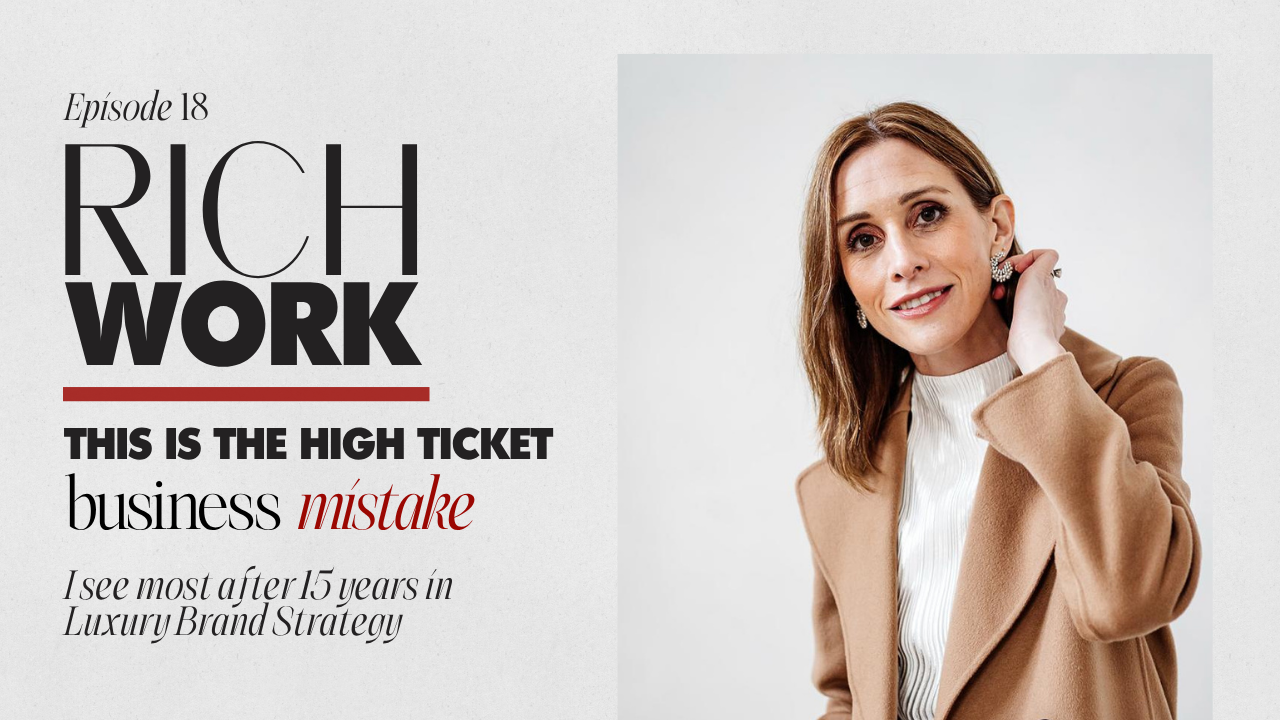
This Is the High Ticket Business Mistake I See Most After 15 Years in Luxury Brand Strategy [ep. #18]
LISTEN ON:
Every high ticket business owner I know has felt it. You love the work. The clients are good. The money is good. And yet there is a slow drip in the background, like someone left a tap running, and your energy is draining away bit by bit.
You keep selling. Revenue goes up. You move through your plans. Still, that feeling does not lift. One and one is not adding up to two, and you cannot work out why.
Most women in this position are told it is burnout. Too much work. Weak boundaries. The fix, apparently, is to pull back and do less. Sometimes that is true. But in most cases it is not what is happening at all.
The drain rarely comes from doing too much. It comes from underpricing the work that matters most to you. The thing that flows out of you so easily it barely feels like working. The skill you have quietly decided does not count, because surely something that comes this naturally cannot be the thing worth the most.
It can. And in the world of luxury brand strategy, it almost always is. The hardest parts of premium work are the ones that have been so completely absorbed that what remains just looks effortless. That ease is not an accident. It is the product.
So before you cut your hours or tighten another boundary, it is worth asking whether the real issue is something else entirely. Whether the most natural gift you have is sitting inside your lowest priced work, quietly wearing you down.
That gap between what you give and what you charge is where we are going next.
Why We Don't Charge for the Things That Feel Easy
There is a story most of us carry without ever questioning it. The story says effort equals value. The harder something is, the longer it takes, the more we sweat over it, the more we feel allowed to charge for it.
So when something comes easily, we do the opposite. We decide it cannot be worth much. If it took no real effort, if it felt like breathing rather than working, then surely it is not a skill at all. It is just who we are.
And that is exactly where the problem starts.
The work that flows out of you with no friction is not lesser work. It is often the most refined thing you do. It feels easy because you have spent years getting to the point where it feels easy. The ease is the result of the skill, not a sign that the skill is small.
But we do not see it that way. We attach a quiet moral judgement to it. Charging a lot for something that felt hard seems fair. Charging the same for something that felt effortless seems greedy, almost like getting away with something.
This is why underpricing your services so often happens with the exact work your clients value most. You discount the thing that comes naturally because it costs you nothing in the moment, while your clients are sitting there thinking it is the most useful thing you have ever done for them.
The gap between how you value that work and how they value it is enormous. They would pay a premium price for it. You are handing it over for next to nothing, sometimes for free, because you cannot quite believe something so easy could be worth real money.
Until you close that gap, the energy drain continues. You can raise your prices on everything else, tighten every boundary, take on fewer clients, and still feel it. Because the thing draining you was never the volume of work. It was the mismatch between what you give and what you let yourself be paid for.
What a Dubai Hotel Taught Me About Charging for Ease
I stayed at a hotel in Dubai that I have not stopped thinking about since.
Before I arrived, they messaged me on WhatsApp. Not a generic booking confirmation. A real conversation. They asked how I liked my eggs in the morning. They asked the temperature I wanted my room set to before I walked in. They asked what I liked to drink so it was waiting for me.
By the time I got there, everything had been handled. There was no friction anywhere. Nothing for me to think about, ask for, or chase. It all simply happened.
What struck me was that none of that felt like effort to them. The whole point was that it looked effortless. The ease was the entire experience I was paying for.
The effortlessness is not a nice extra sitting on top of the product. The effortlessness is the product. People pay the most precisely when something feels calm and handled, not when they can see how much work went into it.
Now take that back to your own work.
The thing you do that feels effortless to you is the exact thing your clients experience as ease. They are not paying for your struggle. They never were. They are paying for the way the problem disappears when you handle it.
When you treat that ease as if it is worth less, you are pricing against the very thing that makes you worth paying for. You are doing the opposite of what every premium business in the world does on purpose.
The hotel did not apologise for making it look easy. They charged more for it.
The Thing I Gave Away for Free for Years
I need to own something here, because I spent a long time getting this wrong myself.
For years I gave away access to my network for free. If someone needed an introduction, a name, a door opened, I made it happen and never thought to attach a price to it. Charging for it felt deeply uncomfortable. It felt elitist. It felt like a pay-to-play thing and that is not how I want to operate.
So I kept handing it out, again and again, telling myself it was just being generous. Being a connector. Being the kind of person who helps.
Then one day I had to really check myself on it. I looked at what was happening and asked, why am I not more protective over this? Why am I treating one of the most powerful things I have as a throwaway?
And the realisation that followed changed how I saw the whole thing. The network was not the product. My reputation was the product.
People were not just getting a name and an email address. They were getting my judgement. My discernment about who is worth knowing and who is worth an introduction. The trust I had built over years, that meant when I vouched for someone, the door actually opened.
That is premium positioning in its purest form. Not a louder pitch or a higher number on a sales page. It is understanding that the real asset is the thing only you can offer.
Once I saw it that way, everything shifted. I stopped treating the network as a freebie I tacked onto everything. I built it into my one to one work and my mastermind, where it belonged, priced as the asset it genuinely was.
Nobody felt it was elitist. The premium clients understood exactly what they were getting and were glad to pay for it. The discomfort I had carried for years was never really about them. It was about my own belief that something so natural to me could not possibly be worth charging for.
How to Find the One Thing You Have Been Underpricing in Your Business
So how do you actually spot it? The skill you have been giving away, the thing sitting inside your lowest priced offers when it should be the centre of your most premium one?
Start with what people say when they refer you. Listen to the exact words. Not the service they name, but the reason they give. The phrase that comes up again and again when someone explains why they sent a friend your way. That phrase is usually pointing straight at the thing you undervalue most.
Then look at what your best clients keep coming back for. Not the deliverable on the invoice. The deeper thing underneath it. The reason they stay when they could go anywhere.
Here is the question I want you to sit with: If you stripped back everything in your business to the one thing you do best, the thing that feels like breathing rather than working, what would be left?
That thing. The one you almost dismissed as just who you are. That is your most premium offer hiding in plain sight.
This is why I keep saying it is not really a pricing problem. You can raise your rates all you want, but if you still believe deep down that your most natural gift does not count, the number on the page will never hold. It is premium positioning first. It is a belief problem before it is a pricing one.
When you get clear on the real value of the work that comes easily to you, two things shift at once. You start attracting premium clients who want exactly that, because you are finally naming it and putting it at the front. And the slow drip stops, because you are no longer pouring your best work into your cheapest container.
The premium clients are not looking for the person who worked the hardest. They are looking for the person who makes the hard thing look easy. That ease, the one you keep waving away, is the precise thing they will happily pay a premium for.
So stop hiding it inside everything else. Pull it out. Name it. Build around it. The work that feels like nothing to you is very often the most premium thing you offer.
Why This Changes How Premium Clients See You
Once you name that skill and put it at the centre of your offer, something shifts in how you are perceived. You stop being one of many people who do the thing, and you become the person known for the specific way you do it.
That is the heart of strong premium positioning. You are no longer competing on the deliverable. You are the only option for the particular experience you create, because nobody else does it quite the way you do.
This is also what changes the kind of people who show up. Attracting premium clients has very little to do with shouting louder or polishing your sales page. It comes down to naming the thing you are genuinely best at and pricing it like it matters.
When you treat your most natural gift as the throwaway, you draw people who want the cheapest version of you. When you treat it as the centre, you draw people who value exactly what you do best and are happy to pay for it.
The work does not change. The way you hold it does. And that is what the people you most want to work with respond to.
Key Takeaways
The slow energy drain in a profitable high ticket business is rarely burnout. More often it is the quiet cost of underpricing the work that comes most naturally to you.
Ease is not a sign that a skill is small. The work that feels like breathing rather than working is usually the most refined thing you do, and the very thing your best clients keep coming back for.
A strong luxury brand strategy treats effortlessness as the product, not a bonus. The Dubai hotel did not charge less because everything felt seamless. It charged more.
The fastest way to spot what you have been underpricing your services on is to listen to the exact words people use when they refer you, then build your premium positioning around that one thing rather than burying it in your cheapest offer.
FAQ
How do I know if I am underpricing my services?
We tend to assume that if something comes without effort, it cannot be worth much, so we quietly leave it out of our pricing. Listen to what clients say when they refer you and what they keep coming back for. If the same strength comes up again and again, and it is something you have been treating as a throwaway, you are almost certainly underpricing your services. Ease is the result of skill, not a sign the skill is small.
What does luxury brand strategy teach about pricing?
Strong luxury brand strategy treats effortlessness as the product rather than a bonus sitting on top of it. Think of a high end hotel that handles every detail before you arrive, so there is no friction left for you. None of it feels like effort to the guest, and that is the entire point. People pay the most when something feels calm and handled. The same applies to your work. The smoother and more seamless the experience you create, the more it is worth, not less.
CONNECT WITH RACHEL:
The Debrief Telegram group: https://rachelpearson.kartra.com/page/debrief
Resources mentioned in this episode:
Calibration Mastermind: rachelpearson.kartra.com/page/Calibration-mastermind
Related Episodes You May Enjoy:
More about Rich Work:
Welcome to Rich Work, the podcast for Welcome to Rich Work, the podcast for established women entrepreneurs who know they should be charging more, but haven't cracked the code on premium positioning yet.
I'm Rachel Pearson, a Global Brand & Business Strategist who spent 15 years building luxury brands like De Beers and launching an airline during a pandemic. Now I help women scale to consistent 5 and multi-6 figure months without the constant proving or over-delivering.
Every week, I break down how luxury brands create desire (think: Chanel, Hermès) and how to apply those principles to your business. You'll get premium positioning strategy, high-ticket business moves, and the identity shifts that actually let you hold the wealth you're building.
This is for women ready to attract clients who pay in full, build the life (the retreats, the calm mornings, the legacy work), and stop following someone else's playbook.
If you're done playing small, you're in the right place. Connect with me on Instagram @rachelpearson.co. Ready to rewrite the rules?
Transcript
[00:00:00] The most premium things in the world, the experiences, the objects, the services that command the highest price points and the deepest loyalty, and this is a really important point, are almost never the ones where the effort is the most visible thing. They're the ones where everything difficult has been so completely absorbed that what remains just looks like it was meant to be.
[00:00:23] Effortlessness is not incidental to the value. It's not something that just happened to happen. It is the value. Welcome to Rich Work, the podcast for established female entrepreneurs ready to turn their expertise into premium clients and consistent high ticket revenue. I'm Rachel Pearson, global brand and business strategist, skincare obsessed and always distracted by booking the next mini break.
[00:00:50] Here, you'll learn how to position like a luxury brand, attract clients who love to invest and build wealth that lasts, so you can create the business and life you want, not someone else's version of success. This is where premium positioning and building a high ticket business meet, for women who are rewriting the rules.
Why Your High Ticket Business Feels Draining Even When Revenue Is Up
[00:01:08] Let's get into it. If you are feeling apathy towards your business, things feel a bit slower, you're overthinking decisions, you're not as excited for the plans you've got in place even though you're making great money, you have clients that you love working with, and you're thinking, "why is one and one not adding up to two here?"
[00:01:32] Today's episode is very much for you. We're going into something that I think is misdiagnosed a lot in the premium coaching and high ticket business space. And because it gets misdiagnosed, the solution people reach for makes the problem worse. This is what I see happening. You are doing great work, you love the work, and it still feels like a slow drip, like somebody's left the tap on and there's this drip in the background where your energy is getting drained bit by bit.
[00:02:07] And even when your revenue goes up, even when you're selling more, you're moving through things, you're getting stuff done, it still doesn't feel like that's lifting. What I see diagnosed a lot when this is happening is people saying, "you're overworked. There's a lack of boundaries. You're on the verge of burnout, moving in that direction."
The Reason Is Not Burnout Or Too Many Clients
[00:02:30] And it leads people to then do less to protect their energy, understandably. We want to pull back if we think, "well, this is because I'm giving too much out there, so I should be pulling back." And it can be one of those things. It can be that the boundaries need to be tightened up. It can be that there's too much work being done.
[00:02:50] But in most cases, that's not what's happening. The exhaustion, the feeling of that slow drip of energy going, isn't coming from too much work. I often see this with clients, because they are women who get really lit up. When they're in the work they do, they could go for days and days, and it's like they forget what time is, they forget to eat, not because anything is wrong, they're just so in it.
[00:03:14] They are not women who shy away from hard work. It's not that they're doing too much, it's this one thing. It comes from under earning in the work that matters most to you. You are giving away the most valuable thing you have, and you are not pricing for it. Today we're going into why this happens, why the thing you would happily do for free is almost certainly the thing you should be charging the most for, and what stories we attach to pricing our most natural gifts that quietly drain us over the long term.
Underpricing The Work That Comes Most Naturally To You
[00:03:48] So let's start with the pattern I see. With a lot of established women in business who come to work with me on their positioning, when we get into it, it goes like this. They have a body of work that is really good. They have offers, frameworks, methodology, things they've built deliberately.
The Pattern I See With Established Women In Business
[00:04:08] They can articulate it clearly, and yes, there's always something we can sharpen, and there are things they want to deepen into, but there's something underneath it that I see. There's a way of seeing, or a quality of access, or a kind of thinking that their clients get consistently, that they name as the real reason working with them is different.
[00:04:31] And if you want to go into what this might be for you, I highly recommend listening to the Wild Card episode, which is linked in the show notes. That one is about finding your wild card. But almost without exception, the thing they say to me is that their edge, their way of doing things, is underpriced, or they're not pricing it at all.
[00:04:53] It gets bundled into something. It gets mentioned as a benefit. It's treated as the thing that makes the work special, rather than the thing the work is built around. And then we get into why.
Why Ease Makes You Believe Your Best Work Is Not Worth Charging For
[00:05:15] So why is this thing you have, this way of thinking, this network or this access, whatever it is, why isn't it centred? Why isn't it priced at the level it deserves? And the answer is almost always a version of, "well, it just comes so easily to me. It doesn't feel like work. It would feel wrong to charge for it." The thing that flows most naturally from you is the thing you've decided doesn't deserve a premium price point.
[00:05:36] And I want you to sit with that statement for a moment, because it's one of the most costly beliefs in the high ticket business space, in any business, but especially here, because this is what a premium mindset client is going to pay for. And it doesn't just drain your revenue, it drains a specific kind of energy, because you're doing your most essential work and you're not getting paid for it at the level it deserves.
[00:06:03] That has an energetic impact on how you perceive yourself and the value of your work, and that feeds into how you show up, which then affects your sales and affects the clients you believe you're right for. You see how it starts to become a bit of a cycle. So let's go into the psychological root of why ease feels like it disqualifies value.
The Moral Story You Attach To Pricing Your Gift
[00:06:25] The reason this happens isn't about confidence. I'm not talking about imposter syndrome in the traditional sense. It's something more specific. Most of us have been conditioned to equate effort with value. So if something is hard to produce, it's worth more. If it takes time, it justifies the price.
[00:06:47] If there's a clear methodology, steps, a framework, something you can teach, then it feels more legitimate to charge for. But the thing that comes easily, that feels more like breathing than working, doesn't fit into that effort equals value equation. So we unconsciously decide it isn't really a product, it's just who we are.
[00:07:10] And then we attach a moral story to the pricing. For example, mine was that charging for access to my network felt like pay to play. It felt like charging was creating an elite version of business that I didn't like, and so I didn't put any cost on it.
[00:07:34] And maybe for you, charging for your way of seeing feels like charging for your personality, or charging for the intangible thing that isn't a deliverable, isn't a framework, isn't something you can put into a PDF, and you feel you can't justify going higher with it. And this is where I bring in my background of 15 years in luxury brand strategy, because this is backwards.
What Luxury Brand Strategy Knows About Effortlessness And Premium Positioning
[00:08:02] Effortlessness at the highest level, at a luxury level, is the product. The luxury world has always known this. It doesn't mean they don't create high quality, it's very much about craftsmanship and high quality, and you can't just say, "oh well, it was so easy to go and buy that Chanel bag, but look, it's fallen apart."
[00:08:23] Nobody's going back to that brand again. However, the service that makes it feel so effortless is also what you're buying into when you buy into a brand. The clearest example I can give you is when you go to a really high end hotel, so in the hospitality industry.
How A Luxury Hotel Removes Every Bit Of Friction
[00:08:43] If I think about experiences I've had in hotels, like one hotel in Dubai, the One and Only, as soon as you go in you have a personal concierge who is on WhatsApp with you, checking in to see what you'd like to plan for the day ahead.
[00:09:02] What restaurants would you like booked throughout the week? It's just on WhatsApp. It's really easy. You go for breakfast and they ask, "would you like room temperature water? Would you like cold water? If you ask for eggs, would you like them soft, medium or hard boiled? What temperature would you like your eggs cooked at?"
[00:09:18] Everything is about ease. It's removing friction from the experience. So yes, it's about a beautiful hotel in a location with a lovely beach and pool, and everything is really high quality, but it's also about the ease of staying there that comes along with it. The most premium things in the world, the experiences, the objects, the services that command the highest price points and the deepest loyalty, this is the type of experience that makes somebody fall in love and get a little obsessed with the way you do things.
[00:09:53] They are almost never the ones where the effort is the most visible thing. Those hotels are not selling based on how many pools they have or the square footage of the room. They're the ones where everything difficult has been so completely absorbed that what remains just looks like it was meant to be, like it could only ever have been this way.
[00:10:15] So effortlessness is not incidental to the value. It's not something that just happened to happen. It is the value. It's the proof that someone has operated at this level for long enough that the hardest parts have become second nature. You cannot fake it, you cannot manufacture it, and you absolutely can charge for it.
How I Stopped Underpricing My Network And Started Charging For My Reputation
[00:10:40] So let me go further into my own version of this to give you an example to work with. As I mentioned, mine was around my network. I have a really strong network. I don't just mean in a LinkedIn sense, but in the sense of relationships I've built over almost 20 years across luxury brand strategy, across the business world, across spaces that most people in the coaching industry don't move through.
[00:11:07] When I launched this podcast and held the launch in a hotel in London, I had people I worked with 12 years ago, clients of mine from luxury brands, come along. I had women who now work in some of the biggest high level hotels, brands you would know, come along, and that's because of the relationships I've built and nurtured, and because of the quality of the work.
[00:11:34] When I thought about this network for a long time, the introductions that come from it, the doors it opens, the rooms it creates access to, they were not part of how I valued myself, because I love doing it. I told myself a story that it's really about women building wealth and sustainable businesses, and part of that is them having more opportunities to have conversations that open doors for them.
[00:12:02] And it's a big passion of mine too, so that was another reason I didn't attach any real value to it. I kept introducing clients to other people, which was great, and sometimes those conversations would lead to new clients, new opportunities, press, or invitations into spaces they hadn't had access to before.
[00:12:27] And when I really looked at this, because it was happening time and time again, I was also really conscious that this is my reputation. Whenever I introduce somebody to my network, it's about how it reflects on me. And I thought, "why am I not more protective over this?" The story I had told myself was, "if I charge for access to my network, that's elitist.
[00:12:54] That's not how I am, and that's not how I want to operate." And I had to check myself on that, because when I really examined that story, it had nothing to do with the reality of what was happening. The network isn't a product. It's not something I was ever going to charge people access to.
[00:13:14] I'm not an introductions agency, and that's how I was treating myself. It was that my reputation is the product. I was not charging for my decades of showing up in spaces with integrity, of building relationships with people who trusted me, of knowing not just who to introduce, but when and why, and whether it was the right opportunity for them or not.
[00:13:37] And that was what I was not recognising as valuable. The curation, my judgement, the decades of context. An introduction from me meant something specific, and that's not pay to play. I was valuing it on a completely different model. That's about leadership. That's intangible, which is exactly why it was so hard to price and why it needed to be priced deliberately.
[00:14:01] So how I've done this now is that when clients work with me one on one and with my mastermind, they do get access to that network, in terms of introductions I'll help them make and opportunities I spot for them. It's not because I'm charging separately for the introductions, but because I charge appropriately in those spaces for everything I bring, not just the strategy, not just looking at your content, not just the number of coaching calls we're doing or the retreats we go on, but the intangible I bring, and the network is part of that.
[00:14:38] It sits inside those spaces, and it's priced for the full depth of what I provide, not just the deliverables I can itemise on a sales page. So I stopped charging for the introductions and I started charging for my reputation, the reputation that makes the introductions mean something.
Your Best Work Should Not Live Inside Your Lowest Priced Offer
And I want you to think about this for your business, because there's a piece that doesn't get said enough in the online service space. When you underprice the thing that flows most naturally from you, you don't just lose revenue, you create a dynamic where your most valuable work lives inside your lowest priced offers.
[00:15:18] So clients get the deepest access to what you do best and are paying the least for it. Over time, that inversion is what creates the sense of exhaustion I spoke about at the beginning of this episode. It chips away. It's not always from overworking, it's from the specific drain of knowing that what you're giving isn't being received at the level it deserves.
[00:15:42] It's not always burnout, it's a misalignment between the depth of what you're offering and the way you've positioned and priced it. You cannot sustain giving your best work from inside an underpriced offer. Over time, I've experienced it, and I see it with clients again and again, it will chip away, it will erode, and you'll start to feel a tiredness that sometimes moves into resentment.
How Off Pricing Repels The Premium Clients You Want
[00:16:10] And there's a second piece to this that's also not obvious. When the thing most distinct to you isn't priced at the level of its value, you attract clients who aren't positioned to make the most of it. It's not because they're the wrong people or bad clients, but because the price signals a level that's off, and so you end up attracting clients who are either earlier in the journey, or not quite right, or don't yet have the skill set or the mindset where your best work lands.
[00:16:42] That means your work doesn't land the way it should, which means the results aren't what you thought they could be, which means you work harder to create the impact that should come more naturally, and that also creates that sense of exhaustion, tiredness and drain in your high ticket business, even if you've got a higher number of clients and you're making more money. So how do you start to identify where you've been underpricing your services?
How To Find The One Thing You Have Been Underpricing
[00:17:07] It is almost always the thing clients mention when they refer you, not the methodology, not the framework, but the thing that made working with you feel categorically different from working with anyone else. I had this last week, as I'm recording this episode. I did a client strategy day, a VIP day, and she has worked with a lot of coaches and mentors, with results in some places and not so great in others.
The VIP Day Client Who Named What Made The Difference
[00:17:37] But she sat opposite me and said, "I have never had a conversation at the level we're having now about my work, because nobody has ever got it the way you see it. Nobody has the depth of it. Nobody has the commercial acumen to talk to me at this level in the way we're speaking."
[00:18:00] And that was the biggest thing she took away from the whole day, even though we went through her offer suite, her pricing, her marketing strategy, her ideal client work. We did all these tangible things. She had eight pages of notes and a 30 day plan that fed into a 6 month plan.
[00:18:16] She had all the things to take away, but in a voice note following the day she said, "the biggest thing for me was you seeing and reflecting back to me that this work is for people like you, that you get it, that you hold it at a level I've never experienced. I've never had a conversation like that before." That's not what I gave her, it's who I showed up as, and that's what clients refer to me for too, the level of conversation, the sharpness with which I can see things.
[00:18:46] So what is it that comes up in testimonials that you don't quite know how to use in your marketing, because it's not the obvious "this is the result she got"? What surprised them about working with you? It's harder to categorise. Things like "being in her network changed everything", or "the level of conversation", or "the way she thinks about this is unlike anyone I've worked with".
[00:19:10] It's the thing you do that you've never built a whole offer around, because it feels too intangible, too personal, too much like you're just being yourself, and it's the thing you would spend all your time doing if revenue weren't a consideration. That is one of the clearest signals of all. So the work you would do for free is usually the work you could charge the most for, but that you're bundling up and maybe even charging the least for right now.
Build Your Most Natural Gift Into An Offer Worthy Of It
[00:19:39] And the question isn't whether to price it, it's how to build it into a space, into a way of working, that is worthy of it. My example is that I built my network into my one to one and into my mastermind, which did make some other decisions for me, like the fact that I don't do introductions now outside those spaces.
[00:20:01] I can. I do it when I go to events and spot opportunities and think, "oh, that person would be really good to connect with that person." That's my reputation. It's what I've built over more than a decade. That comes with a cost, but I don't need to charge £10K for an introduction through me.
[00:20:20] That's not how I want my high ticket business to run. That doesn't align with my values. So where does it come into your offers, into your current spaces, into the way you work now, that makes the value clear and signals that this is not a standard offer? This is what I want to leave you with. If you stripped back everything in your business to the one thing that comes most naturally, the thing you do regardless, the thing your best clients name as the real reason they work with you, what would that be, and what are you currently charging for it?
[00:20:50] Not bundled into something else, not part of a package, but the thing itself, what does that thing cost? Because if the answer is nothing, or not enough, that's not a pricing problem, it's positioning first. It's a belief problem. It's a story you're telling yourself about what it deserves to be valued at, a story that drains your revenue and drains the energy that comes from your most powerful, potent work sitting at a level it doesn't deserve.
[00:21:20] It's not simple work to do this, but it's the work that changes everything downstream, the clients you attract, the results you create, the way you feel about what you're building, which is so important. If this has resonated for you, then this is your sign to do something about it, and this is the work we do inside Calibration, my mastermind for established coaches and service providers who are ready to close the gap between their actual calibre and their commercial presence.
[00:22:02] This conversation about pricing the intangible, building offers worthy of your most essential work, attracting premium clients who are positioned to receive it, this is exactly the work we do together. So if this is speaking to you, come and connect with me on Instagram or LinkedIn. My socials are in the show notes below, and find out how we can make sure your work is positioned for the clients you want to be working with, the ones who make you feel energised and excited about your business.
[00:22:19] That's it for today. If you've enjoyed this episode, please leave a comment. Please subscribe to the podcast. Every little bit helps us get this podcast out to more women who are building category defining businesses and changing the premium business space. My name is Rachel Pearson, and this has been Rich Work.
[00:22:37] I'll see you next week. Thanks for tuning in to Rich Work. I'd love it if you left a review, it helps other women find us. In the meantime, follow me on Instagram at rachelpearson.co for a different take on premium positioning, one that's not about fitting a box. See you next week.
© Copyrights by Rachel Pearson. All Rights Reserved.