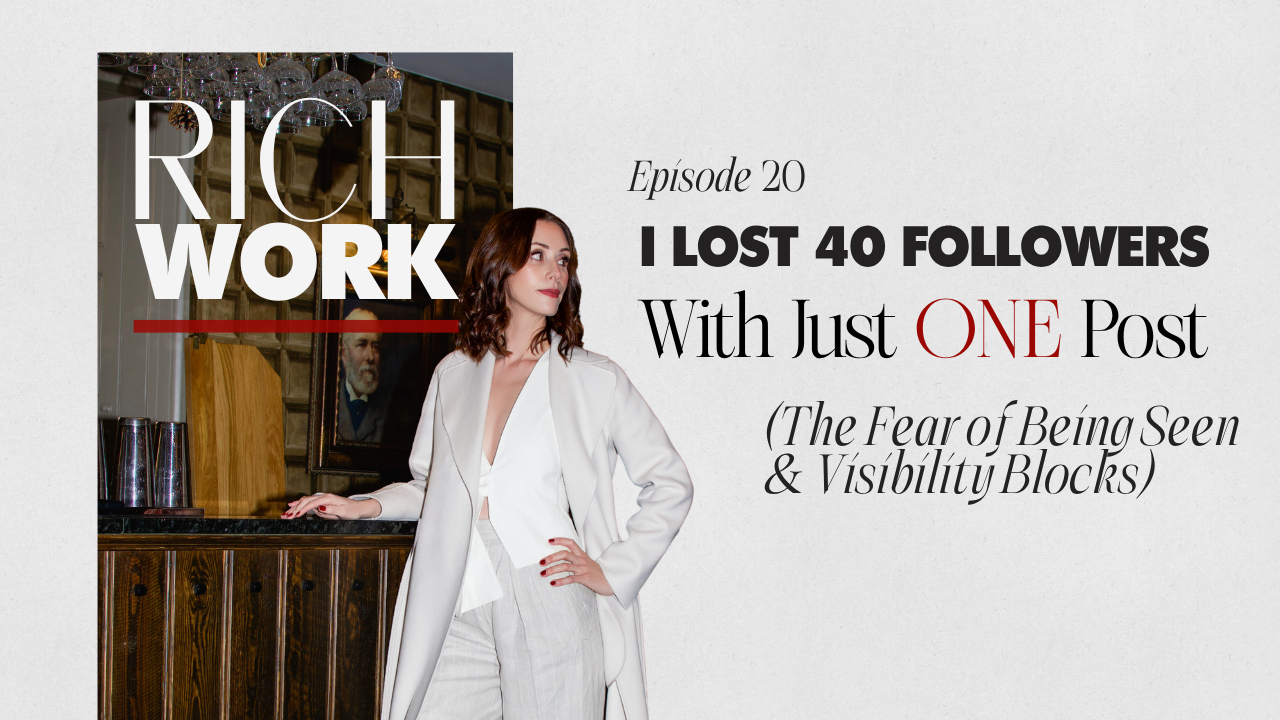
I Lost 40 Followers With Just ONE Post (The Fear of Being Seen & Visibility Blocks) [ep. #20]
LISTEN ON:
My fear of being seen started young. When I was around 10 or 11 years old, my family became highly visible in the press. It was tied to a business in my family, and it was not the kind of visibility you choose. It was a lot, on a scale I was not personally equipped to deal with, and I absorbed most of it through my parents and how they were managing it. I did not experience it directly the way an adult would, but I felt every shift it caused around me.
What I remember most is what it took away. It changed the dynamics in my family. It meant a loss of money. It meant things we had been part of, things that were simply part of our life, were suddenly gone, and we could no longer make decisions the way we used to. At that age, an experience like that leaves a deep impression. Visibility stopped being neutral. It became something I associated with threat, with loss, with the sense that the more seen you are, the more there is to be taken from you.
That association did not stay in childhood. It followed me into adulthood and into every business I built. As I moved into the personal development space, I started to recognise it for what it was: a visibility wound that had been shaping how far I was willing to be seen. I could trace a direct line between that 10 year old absorbing her family's exposure and the grown woman softening her opinions online decades later. The fear of visibility was never loud. It was a background rule I had stopped questioning.
The strange part is that this same wound became one of my biggest strengths. Because I had felt the weight of high visibility so young, I developed an unusually intuitive understanding of what it does to the nervous system, to relationships, to a sense of safety. It is one of the reasons the people who trust me quickly tend to be the ones with the most to lose, the high profile clients and CEOs whose visibility comes bundled with real risk. I understood their fear of being visible because I had been living a smaller version of it my whole life.
The Saturday Morning I Realised I Was Taming Myself
A couple of weeks ago I noticed I was bumping up against a ceiling. I have learned to read my own patterns, and I could feel it coming up. Opportunities had been circulating around me, magazine features, invitations to record in studios, enquiries from the kind of clients who carry high levels of visibility themselves. Everything outside me was pointing towards more visibility, and something inside me was pulling in the opposite direction.
So on a Saturday morning, before the boys got up, I gave myself some rare quiet time. I got out a piece of paper, wrote the word visibility in the middle, and let myself freestyle write everything that came up around it. No structure, no plan, just whatever wanted to come out. If you ever feel stuck on something, I would recommend this before anything else. Do not force it into a neat list. Let your brain run first, then shape it afterwards.
What surfaced was a single sentence that stopped me: I am taming myself in my most visible channels. With my clients I am direct. I name the gaps I see, the places they are holding back, the ambition I know they are capable of. On my Telegram channel I share unfiltered thoughts and nothing is off limits. But on social media, the place I tell everyone is where you go to be visible for your business, I was filtering. I was authentic, but I was holding back the sharpest part of my opinion.
That was the pattern, laid bare. My highest visibility channel was the exact one I was avoiding. Not consciously, not deliberately, but the fear of being seen had found the place where it could do the most quiet damage and settled there.
The Gap Between What You Tell Clients on 1:1 Calls and What You Post Online
This is where it gets uncomfortable, because the gap is so easy to miss. From the outside my content looked authentic. I was not faking anything. But authentic and honest are not the same thing. I was showing a true version of myself that still left out the opinions with the most weight, the beliefs I would say without hesitation if you were sitting in front of me.
Think about how you speak on a 1:1 call with a client. You are direct. You tell them where you see the gap, where they are playing small, what needs to change. You own your ambition out loud. Now look at what you actually post. For most people there is a noticeable distance between the two, and that distance is where the visibility blocks live. Not in a lack of content, but in the difference between your private honesty and your public voice.
I could feel that distance in myself. The conversations I was willing to have 1:1 were sharper than anything I was putting on Instagram, LinkedIn or Facebook. And the reason was not strategy. It was that social media registered as high visibility, and high visibility registered as a threat. So my brain did what it had always done. It softened the edges, kept me safe, and called it being measured.
But when you hold back your real opinion, you blur the exact thing that would let someone recognise you as the person they have been looking for. You stay visible enough to be present, but not visible enough to be chosen. Closing that gap is not about posting more. It is about being willing to say in public what you already believe in private.
What Happened When I Finally Posted the Thing I Was Holding Back
Once I could see the pattern, I knew what I had to do. The edgiest thing for me, the place I had been avoiding most, was being unapologetic about the wealth and the life I have built. The story underneath it was that if I talked openly about my lifestyle, people would assume I was one of those shiny coaches who sells well and does not deliver. That fear of visibility was running the show, dressed up as a content problem.
Because I had already processed it on paper, I knew this was not going to be reactive. I was not posting to prove anything or to convince anyone. I wrote a carousel sitting outside by the pool at my house, before I had poured the glass of wine, and I was the most specific I have ever been about my actual life and what I am here to change. Then I posted it. And almost immediately, I felt physically sick, the kind of sick where you genuinely think you might throw up.
The unfollows started within minutes. Over the couple of weeks since, I have lost somewhere between 35 and 40 followers. I have a small audience of around 4,000, so relative to my usual posts, that is high. If I were measuring success by follower count, that single post would look like a failure. For a moment, with that wave of nausea, it certainly felt like one.
But that is not the whole story. That same post brought almost 100 profile visits and 3 enquiries for my highest investment 1:1 work. I did not write it to make money, and that matters, because content created from that place tends to mirror it straight back at you. I wrote it from the truth, and the result was a small number of the wrong people leaving and a handful of exactly the right people arriving. That is what attracting clients from raw honesty looks like and that is the trade most people are too afraid to make.
Being Visible Without Performing or Getting Controversial
There is a story going around online that says you have to be polarising to be paid well. That you need hate comments, a spicy hot take, people who actively dislike you. I do not believe that, and my experience does not support it. Yes, that post lost me followers. Yes, some people disagreed. But I did not set out to provoke anyone. I was not performing controversy to manufacture reach.
This is the distinction that is important. Going to the edge of your truth is not the same as being controversial for the sake of it. One comes from saying the thing you have been holding back because it is real. The other comes from saying something inflammatory because it gets a reaction. They can look similar from the outside, but they come from completely different places, and people feel the difference.
Leadership is not about being divisive. It is about unwavering truth and unwavering certainty in what you stand for. When you lead from there, you naturally repel the people who were never yours and you draw in the ones who were always looking for you. That is what makes attracting clients at the highest investment level feel easy rather than forced. You are not chasing anyone. You are simply being clear enough that the right people recognise you.
So no, you do not have to change how you speak or who you are to be seen at a high level. You have to be willing to stop filtering the truth you already hold.
The One Question to Ask Yourself About Your Own Visibility Blocks
If your business has hit a plateau and you suspect visibility is the reason, most people will tell you to ask where you are holding back. I think that is the wrong question.
The better one, the one that actually changes things, is this: what responsibility do you associate with your visibility?
Is it the responsibility of holding success once you have it? The responsibility of failing publicly? The responsibility of managing what other people will think, the comments about who you think you are, the assumption that you have changed or become arrogant or talk about money too much? Whatever it is, that responsibility is the real weight behind your visibility blocks. It is the thing capping you, not your content and not the algorithm.
Once you can name it, you can separate the emotion from the fact. You can see it as a story you have been carrying rather than the truth. And from there you get to decide what to put in place so it stops running your decisions, whether that is creating more safety in your body when you show up, reminding yourself of the responsibility you are no longer willing to hold, or setting clear boundaries around what you share and what you keep private as you grow.
This work is never ‘one and done’. The bigger you get, the more it will resurface, because every new level of visibility introduces people, rooms and judgements you have not faced before. That is not a sign to shrink. It is a sign to keep strengthening the new association, the one where being seen is safe, until your truth is louder than the old story.
Key Takeaways
The fear of being seen is rarely a confidence or content problem. It is usually an old association between visibility and threat, formed long before your business existed.
Watch the gap between what you say privately and what you post publicly. That distance is where your visibility blocks live, and closing it is what makes the right people recognise you.
Losing followers after an honest post is not failure. One true piece of content can repel the wrong audience while attracting clients who are ready to invest at the highest level.
The question that shifts everything is not where you are holding back, but what responsibility you have attached to being visible.
FAQ
What is the fear of being seen in business?
The fear of being seen in business is the discomfort that surfaces when you become more visible, share your real opinions, or own your success publicly. It often shows up as holding back on social media, softening your message, or avoiding your highest visibility channels, even when you feel confident on client calls or in person. It usually is not a confidence or content problem. Underneath it sits an association you have made between visibility and something you would rather avoid, like judgement, loss, or the responsibility you believe being seen demands of you.
How to overcome fear of being seen?
You overcome the fear of being seen by working on the belief underneath it, not just by posting more. Start by naming what you associate with visibility, often loss, judgement, or pressure, then expand your capacity in small steps rather than forcing a dramatic leap. Notice where you are more honest in private than you are online, and close that gap one post at a time. This is ongoing work, not a single breakthrough. Each time you share your real opinion and survive the discomfort, you strengthen a new, safer association with being visible.
Where does fear of being seen come from?
The fear of being seen often comes from an early experience where visibility felt unsafe or led to loss. For many people it traces back to childhood, a moment when being noticed brought judgement, consequences, or a shift they could not control, and the brain learned to associate being highly visible with threat. That association can sit dormant for years, then resurface as your business grows and asks you to be more visible. The fear is rarely about the present moment. It is an old story about what visibility costs, still running underneath.
More about Rich Work:
Welcome to Rich Work, the podcast for Welcome to Rich Work, the podcast for established women entrepreneurs who know they should be charging more, but haven't cracked the code on premium positioning yet.
I'm Rachel Pearson, a Global Brand & Business Strategist who spent 15 years building luxury brands like De Beers and launching an airline during a pandemic. Now I help women scale to consistent 5 and multi-6 figure months without the constant proving or over-delivering.
Every week, I break down how luxury brands create desire (think: Chanel, Hermès) and how to apply those principles to your business. You'll get premium positioning strategy, high-ticket business moves, and the identity shifts that actually let you hold the wealth you're building.
This is for women ready to attract clients who pay in full, build the life (the retreats, the calm mornings, the legacy work), and stop following someone else's playbook.
If you're done playing small, you're in the right place. Connect with me on Instagram @rachelpearson.co. Ready to rewrite the rules?
Transcript
[00:00:00] So my association was, the more visible I get, the more I have to hold onto it, the more I have to control it, the harder it will be for me, the more I have to lose. That is what visibility represented to me. That is the responsibility that I had told myself I have to hold because of the experiences I had growing up.
Why Your Business Has Hit A Visibility Block
[00:00:17] If you are listening to this and you feel that your business has hit a plateau because you have hit a visibility block, then the question I am going to ask you is not where your fear of being seen is holding you back, it is what responsibility do you associate with your visibility? Welcome to Rich Work, the podcast for established female entrepreneurs ready to turn their expertise into premium clients and consistent high ticket revenue.
[00:00:42] I am Rachel Pearson, global brand and business strategist, skincare obsessed, and always distracted by booking the next mini break. Here you will learn how to position like a luxury brand, attract clients who love to invest, and build wealth that lasts, so you can create the business and life you want, not someone else's version of success.
What It Takes To Hold Visibility At A High Level
[00:01:02] This is where premium positioning and building wealth meet, for women who are rewriting the rules. Let's get into it. How would it feel to speak on stage in front of 10,000 people? What about 100,000? 1 million? I mean, why not? Let's just go there. I do not know how it feels to speak in front of that many people.
[00:01:24] I have not done it. I am very transparent about this. But in this week's episode, I am going to be sharing a perspective on what it takes to hold visibility at a high level, one that has come from my experience working with clients, but also from my own personal experience. And when I say visibility at a high level, that often means more people, but it can also mean being visible because you are getting sharper about what you communicate and clearer around your truth.
[00:01:53] And not everybody is going to understand that, accept it, or like it. I do not mean that this is about creating content or being visible to be controversial for the sake of it and getting engagement. This is about when you do not hold back on what you believe in, and when you start to share more from your truth and your opinion, that carries its own weight around visibility.
[00:02:19] And I do not think we have this conversation enough in the online space. We have lots of conversations around the importance of visibility and how to be strategic, which platforms to be on, how to use Reels, how to trick the algorithm. You cannot trick the algorithm, by the way, but that is another episode.
[00:02:37] We do not have many conversations around what it takes to hold that, the identity around it, and that is what I am going to bring in today. To give you some context, I have always struggled with visibility in my life and in the different businesses I have built. It is not that I have a fear of being seen, or that I find it hard to stand up and talk in front of people.
[00:03:05] I find it easier to present and talk in front of large groups than I do in front of 20 people. I do not know. Maybe it is that I put on my equivalent of Beyoncé's Sasha Fierce, and I can get into that mindset, and it really energises me to talk in front of a lot of people. The hard part for me is that it has carried a negative association, which I have worked on a lot, but it does keep coming up and bumping up, and this is what I am going to be sharing in this week's episode.
[00:03:34] You will not have the same experience as me, but it will help you to open up and maybe question whether you are, in your strategy, doing things to make you more visible, while underneath there is some kind of energetic or belief running beneath it, which is really the thing holding you back.
Where My Fear Of Being Seen Came From
[00:03:51] When I was growing up, when I was around 10 or 11 years old, I had an experience which I will not go into in today's episode because it is not my story to share, but I had an experience in my family where we became highly visible in the press. It was known in school. I had children commenting on it when I went to school.
[00:04:11] Their parents mentioned it to me, and it was to do with a business in my family. It was a lot of visibility that I was not personally dealing with on a mass scale, although I experienced it through my parents managing it, so I had it through their filter. But because it really impacted the dynamics of my family, where we had this big amount of visibility and it was negative, it had a negative effect.
[00:04:38] And at that young age, my fear of being seen became very associated with threat. It became something where I believed, I associated, that when you become highly visible, there has to be loss. It changed the dynamics in my family relationships. It meant loss of money. It meant loss of things, things taken away that were part of our life before, and we were not able to make decisions in the same way.
How I Reframed My Fear Of Visibility, One Live Video At A Time
[00:05:04] And obviously, at such a young age, that had a really strong impression on me. Now, as I have got older and grown and done a lot of work on myself, I have been aware, really as I moved into the personal development space, of how this experience has shaped and triggered my fear of visibility, seeing how I associate visibility with threat, with struggle, with things having to be hard when I become more visible.
[00:05:38] And I knew that I really wanted to expand my capacity to allow my visibility to grow. So as I started to get more visible, I have continuously been working on my capacity to hold visibility, and that started off with really simple things like going live more on Instagram. And honestly, my first live, I was absolutely terrified.
[00:06:05] I have spoken in front of a C suite of some of the biggest brands in the world. I have presented at their conferences. I have done all of these things, but pressing that live button scared me to death. My hands were shaking. I had to do it multiple times. I was getting a stress rash on my neck.
[00:06:23] When I say I started small, I started with baby, baby, baby steps, and then I moved into doing smaller events, and I also started to really look at how I could experience visibility differently. How could I reframe the association I had with visibility so that it had a new identity within my story?
Why My Fear Of Being Seen Became My Strength With High Profile Clients
[00:06:48] And I could start to see the power of this experience, and how empowered I could be by getting more visible. Through doing that, which I will be honest has taken years for me to work through and still pops up, it is still something I am very aware of, which I am going to go into in a minute.
[00:07:04] But through doing this work, I started to see that through the experience I had in my childhood, and my fear of being seen, it is one of my key strengths that I have a very acute and intuitive understanding of the impact of high levels of visibility on the nervous system, on relationships, on family dynamics, the importance of creating safety and reassurance in your body, but also the conditions you are setting, the circumstances around it, to have some feeling of control over visibility, whether that is what you say to yourself or the kind of boundaries you have on social media.
[00:07:44] And I started to see that because of the experience I had early on in life, I have a really nuanced way of looking at visibility that was not simply, oh, go out there and become as visible as you can, and your business will automatically fly. Even before I realised I was doing this, I knew that working on identity to be able to hold that visibility behind the scenes was key, and it is one of the reasons I am trusted very quickly by people who have high profiles.
[00:08:13] So celebrities or CEOs of very high pressure businesses that have a lot to lose. Their visibility comes with a threat to privacy. They have wealth, which is also something that can feel really threatened. They do not have a sense of normality, and so visibility is both a driver and a necessity in their business, in their life, and in every bit of success they have built, and attracting clients at that level means it can feel the hardest thing to navigate and to manage.
[00:08:43] And so as I have been doing this work to expand my capacity around visibility, a huge part of the work I did was around how I reframed my own negative associations to visibility. I started to see how that experience I went through has really enabled me to do the work I do now in high proximity, one to one and in Mastermind, that the way I look at visibility and the way I am showing up on this podcast is a strength, but I had to reframe that.
The Work On Fear Of Being Seen Is Never 'One And Done'
[00:09:15] And this is continuous work. This is what I really want to share in this episode. Whatever stage you are at in business or in your own visibility, this work on your fear of visibility is not, unfortunately, one and done. It is not that I have now broken through and associated positive things with visibility and this will never come up for me again.
[00:09:37] This is continuous work. This is me strengthening the positive association I have with visibility, with me standing in my truth, with me being sharper in my beliefs and what I stand for, and it is something I continuously connect back in with.
[00:09:57] Because as you get more visible, as your business grows, you will open yourself up to more judgment, to more perception, and to your own perception as well. The stories, the triggers, they will come through too, because you are expanding into new levels of being seen by more people, by different people, and that is often when the fear of being seen resurfaces, whether that is in press or on podcasts or standing on a stage in front of 1,000 people.
[00:10:29] It is the unknown of visibility that creates the sense of, I do not have certainty in this yet, and that unknown is where the fear of being seen tends to live. But that does not mean you need to shrink back or create a new strategy around visibility. The key part for you is being able to strengthen your self trust and your own association with what visibility brings to you.
The Morning I Realised I Was Taming Myself Online
[00:10:53] Now, I have recently had a boost in this work for myself. I had to really come into this work over the last couple of weeks because I recognised, because I am very aware of my own patterns, that I was bumping up against a ceiling, and I could feel that it was a visibility block. So, a couple of weeks ago.
[00:11:14] Over the last month, I would say, I have been going through opportunities where visibility has really been circulating me. I have had opportunities through magazines and other PR. I have been invited to record podcasts in studios. When it comes to attracting clients, the ones I am getting inquiries from and starting to work with, they have high levels of visibility or are looking to really move to that as well.
[00:11:41] And I could feel that this was being reflected back to me, but I also felt there was some kind of ceiling coming up in me. So I sat down, this was a couple of weeks ago, it was a Saturday morning, before the boys got up, and I had some rare quiet time to myself. I got out a piece of paper, and I put the word visibility in the middle, and I just started to let myself freestyle write about everything that was coming up for me.
[00:12:06] And the thing that came through was, I am taming myself in my most visible channels. What that looked like for me was, I am having conversations, I am really direct in my client work. With my clients, I have direct conversations about where I see gaps in their business, where I think they are holding back, and the limitations.
[00:12:30] I am hugely supportive as well, but I know they have come to work with me for a reason, that they want to change. So I am direct in those conversations. I also own the level of success I want and the ambition I have with my clients. I do it on this podcast, which seems a bit ironic because I know this podcast could go out to millions if that was what happened on the platform.
[00:12:51] But when I am just sitting here recording it, it just feels like a conversation between me and you. And I have the debrief, a free Telegram channel, where you get unfiltered thoughts about what is going on in my business and the work I am doing with my clients. There I am open, nothing is off limits.
[00:13:09] But I was not doing this in my content, and specifically in my social media content. I am on Instagram, I am on LinkedIn, I am on Facebook. Instagram is my primary platform, LinkedIn is my second. Facebook is sort of rising up as my third, and probably will become my second platform. But I was filtering there. Even though I was being authentic, I was not intentionally holding back.
[00:13:32] But when I look at my content and how I was showing up on social media, I can sense how I was not bringing forward my opinions, the truth of what I am here to create and what I am here to change. And I could sense it is because that feeling, that association I have, is that social media is high visibility.
[00:13:48] It is where you go to get visible for your business, and therefore it is a threat to me. So the pattern coming up for me, which I am so aware of, is that my highest visibility channel, the one I most associate with the fear of being seen, is the thing I am avoiding. So I sat there and I mapped out all this free flowing content. It is a really good exercise if you feel challenged with something. Do not try to force yourself to write into a structure.
The Kitchen Table Exercise That Broke My Pattern
[00:14:10] Go and let your brain be free. That is what we need to tap into first, and then we can go into more of, okay, let us focus on how to structure it and what you want to do from here. So I did this process, and I stepped back and I was like, okay, Rachel, then what do you want to do about this? And I just felt like I needed to stop hiding.
[00:14:29] I was like, okay, so what does stopping hiding look like for you? This is where I am that weirdo who just coaches herself at the kitchen table on a Saturday morning. And the thing that felt edgiest for me at that time was being unapologetic about the wealth I have and the life I have created.
[00:14:47] So some of the things coming up for me were, my edge around visibility was, if I start to talk more about my lifestyle, people are going to hire me because they think I am one of those shiny, glitzy coaches who sells really well but then does not deliver. That was what was going on in my mind underneath me going, oh, maybe it is a content thing.
[00:15:06] Maybe it is my messaging. And it is like, no, this is not it. I love messaging, I work on it a lot, but underneath it, it is a belief. It is wild what your brain can do. But that was the story. So I knew I needed to go to that place in my content to start breaking through the visibility block I had created. And because I had done this process of writing everything down, I had processed it myself, so I knew this content was not going to be reactive.
[00:15:34] I am not trying to just turn up and tell everybody what is really going on and prove it, because that unprocessed emotion, that reactive place, that is felt in your content. So I knew that if I was going to go out and create this message, it had to be this edge where I did not need to prove, but I wanted to be able to tell my truth.
What Happened When I Posted The Content That Scared Me
[00:15:55] And I wrote this piece of content. I did a carousel. It was not in Canva or anything. It was just done on Instagram. I did it when I was outside. I was by the pool at my house. I was drinking a glass of wine. Well, I had not had a glass of wine yet. I did the content first because I wanted it to make sense.
[00:16:11] I just spoke really openly about what I am here to do, what I am here to change, and I was the most specific I have been about my life openly and what my Saturday had been like. And after I posted that piece of content, when I posted it, I felt sick. And I think it is important to say this, because sometimes it is like, no, you should just go out there, be really audacious, post the piece of content, not care what other people think.
[00:16:34] I can stand in my truth, but I am also human, and I felt physically like I was going to throw up when I posted that piece of content. And I knew it was because it was the edge I needed to move through. A couple of minutes after I posted it, I had immediate unfollows. And since then, probably a couple of weeks now as I am recording this episode, I think I have had about 35 to 40 unfollows, and I have a small audience on Instagram.
35 Unfollows And 3 Client Inquiries From One Post
[00:17:03] I have around 4,000 followers, so it is not a massive amount of unfollows, but for my community, relative to my other posts, it is high. For one piece of content, that is high. And at the same time, and it sounds ironic to say it because posting this piece of content was to break through my visibility block, but it was not really to get more visible to more people.
[00:17:27] In time it will. In the long game it will, because by me coming more into my specific truth, speaking more to my specific person, I know this will attract more of them. I have this saying that the power of one goes to the power of many. So when you speak to one person directly, that is when you start to compound, because you will attract more of those right people.
[00:17:48] But right now it is going down. What also happened was I had almost 100 profile visits on my Instagram from one piece of content, which for me is high. I had 3 new client inquiries for one to one work, which is my highest investment, and it is not that I posted this content because I wanted to make more money.
[00:18:13] Again, if it comes from that place, it is a mirror, you will get that mirrored back to you. But I created it from the truth of, I do not need to prove this, I am not performing it, this is what I stand for. And I knew that was where I was capping myself. And wherever you are capping yourself in your beliefs is also where you are capping yourself in the growth of your business every single time.
[00:18:37] So I knew I was bumping up against this visibility block and coming back into old stories, and that I needed to look at this specifically. Not going into, okay, how do I create a reel that goes viral so I can get more people in. That was not the visibility I needed. It was, where is the fear of being seen stopping me from owning my opinions and my brand voice and what I stand for, that means I am not currently visible to the right people?
You Do Not Need To Be Controversial To Attract Premium Clients
[00:18:58] And I wanted to share my own recent experience in this episode because this side of visibility is not what is sold online, especially when you are looking at attracting clients at a higher investment level, a high level client, whatever you want to call them, but a client who is willing and able and desires to spend higher amounts of money because they want a specific result, they have a specific problem, and they are looking for leadership that reflects that back to them.
[00:19:28] You do not need to be controversial or have people dislike you or create hate comments in order for people to pay you a lot of money, and that is the story, the narrative I am seeing go around online. What I am saying is different. Did I have people who did not agree with me from that post? Yes.
[00:19:47] Did I have people who unfollowed me? Yes. Will they continue to unfollow me? Probably. That is what business is. But I did not set out to piss people off so much and have a spicy opinion that would mean I am really controversial, that would get me more visibility. That is not the visibility I am looking for.
[00:20:05] And this is not to shame people who do this kind of highly controversial thing, who know it is going to create this sort of rage reaction. It is their way of doing it. But what I am saying is, you do not have to do it that way. I believe you do have to go to the edges of your truth and call out your own bullshit when you know you are holding back on saying something publicly that you would say to somebody if they were in a room with you.
[00:20:30] If you are having a conversation with your clients, but you are not showing that through your content, there is a disconnect. But you do not, in my view, have to become overtly controversial, change how you speak, or change the things you would say to be seen at a high level of leadership and to keep attracting clients at a certain level.
[00:20:47] That is not what this is about. Leadership is about unwavering truth. It is about unwavering certainty. So I do not think anybody is really challenged with a fear of visibility. I think they can be challenged with how consistent they are with their content, but again, I think there are beliefs that sit behind that.
[00:21:03] There can be challenges with technology and how you create a reel that works with the algorithm and all that kind of jazz. But putting that aside, if somebody says, I really struggle to show up with visibility, I think there is a different question to ask yourself, and that is, what have you associated with that visibility?
[00:21:22] And that is what is going to bring you back into your truth, and it is also going to open up a different way of talking in your content, of tapping into those, what will probably be more controversial opinions, that will have an edge, that will be the things that get unfollows or get comments from people who do not agree with you.
[00:21:40] But it is not from a place of, let me be spicy and let me stand out. It is from a place of, this is my truth that I have been holding back, and I am not willing to do that anymore. So my association was, the more visible I get, the more I have to hold onto it, the more I have to control it, the harder it will be for me, the more I have to lose.
The One Question To Ask Yourself If You Feel A Fear Of Visibility
[00:21:55] That is what visibility represents to me. That is the responsibility I had told myself I have to hold because of the experiences I had growing up. If you are listening to this and you feel that your business has hit a plateau because you have hit a visibility block, then the question I am going to ask you is not where you are holding back on visibility, it is what responsibility do you associate with your visibility?
[00:22:19] Is it the responsibility of holding success? Is it responsibility around failure? Is it responsibility around what other people perceive about you? Who does she think she is? She has changed. God, she sounds arrogant. She is talking about money all the time. What is that responsibility? And then what is the perception you have created for yourself that means you are not showing up in your truth?
[00:22:39] That is what I am going to leave you with, that one question, because if you can start to untangle that, you can separate out the emotion of it. You can see it as a story, a belief you are holding onto, and therefore you get to look at it objectively, and then you get to decide what you put in place so that it does not become your truth anymore, whether that is creating more safety in your body when you show up, reminding yourself that you do not need to carry that responsibility, or whether that is creating some boundaries around what you do choose to share and what you do not choose to share as you get more visible.
[00:23:10] There are so many different ways you can do this, but you have to get clear on the responsibility you are no longer willing to carry, the one that is capping you from getting more visible and from attracting clients who are right for you, that is holding you back from sharing your truth, the truth that somebody will hire you and pay you highly for.
[00:23:28] I would love to know in the comments anything this has sparked for you. And of course, if you are open to leaving a review, I always appreciate it, because this helps Rich Work to get in front of more of the right women. But for now, I am Rachel Pearson, this has been Rich Work, and I will see you next week. Thanks for tuning in to Rich Work.
[00:23:46] I would love it if you left a review. It helps other women to find us. In the meantime, follow me on Instagram, @rachelpearson.co, for a different take on premium positioning, one that is not about fitting a box. See you next week.
© Copyrights by Rachel Pearson. All Rights Reserved.