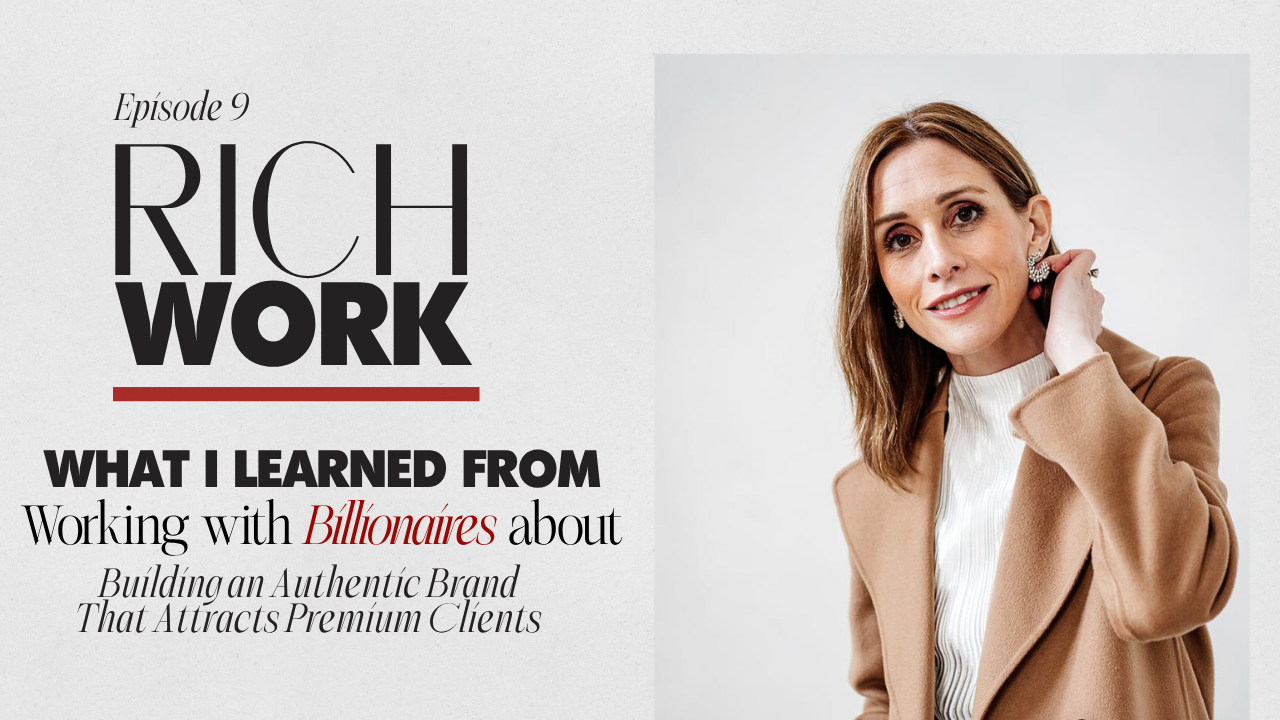
What I learned from Working with Billionaires About Building an Authentic Brand That Attracts Premium Clients [ep. #09]
LISTEN ON:
I nearly didn't record this one.
Not because I didn't have anything to say, but because I had too much, and most of it I didn't want to share. That tension, knowing your story, knowing it's relevant, and still choosing what stays private, is exactly what building an authentic brand looks like for me.
The online space has a very specific idea of what authenticity means. Cry on your stories. Share your worst moments. Make people feel something by giving them access to your pain. And if you don't do that, you're cold. You're unrelatable. You're not connecting.
I've heard that criticism more than once.
What I've never done is change because of it.
This episode of Rich Work is the one I've been putting off the longest. It's the one where I share more of my background, why I think about business and wealth the way I do, and what years of working closely with billionaires, celebrities, and ultra-high-net-worth individuals taught me about premium positioning, identity, and what it really looks like to attract clients who are ready to invest at that level.
It's also the episode where I make the case that showing up online with intention and boundaries is not a weakness. It is the standard.
If you've ever been told your brand is too polished, too private, or not vulnerable enough, this one is for you. And if you've never questioned whether oversharing is the only path to an authentic brand, it's especially for you.
Keep reading, or go straight to the episode. Either way, something in here is going to shift the way you think about your brand.
I've Been Told I'm Not Relatable Enough Online and I'm Still Not Going to Change a Thing
The criticism I get most about my brand is that I don't share enough. That I'm too private. That people can't connect with me if they don't know my full story.
And I understand why people say it. The online space has spent years telling us that vulnerability is the fastest route to trust. That if you want premium clients to choose you, they need to see your struggles, your journey, your worst moments laid out in a caption or a story.
I've never believed that. Not because I'm closed off, but because I've seen what happens when people build their entire brand on their pain points. The moment they heal, or move on, or simply don't want to talk about it anymore, they feel trapped. Their audience expects a version of them that no longer exists.
An authentic brand isn't built on how much you share. It's built on what you stand for, how consistent your standard is, and whether the people you want to work with can feel that standard every time they encounter your content.
The criticism that I'm not relatable enough is, genuinely, one of the best things anyone has ever said to me. Because it tells me that my brand is doing exactly what I designed it to do. It is attracting people who value substance over spectacle. And it is repelling people who would never have been the right fit anyway.
What Embodied Leadership Looks Like When You're Showing Up Online
Embodied leadership is a term that gets used a lot in the online space, often without much clarity around what it actually means in practice.
For me, it comes down to one thing. Knowing what you will and will not share, and holding that line regardless of what the algorithm rewards or what your audience asks for.
Showing up online as a leader does not mean showing up as an open book. It means showing up as someone who has decided who they are, what they represent, and what their presence in a room, or a feed, or a podcast, communicates without them having to say it explicitly.
This is where storytelling in business becomes genuinely powerful. Not because you're sharing everything, but because the stories you choose to tell are so intentional that they say everything about your values without exposing everything about your life.
I think about this every time I plan content. What does this story communicate about the standard I hold? What does it say about how I work, what I believe, and what kind of client I want to work with? If the answer is nothing, I don't share it. If the answer is something, I think carefully about how much context the story actually needs to land.
That is embodied leadership. It's not a mindset exercise. It's a daily editorial decision about your brand.
The Question to Ask Yourself If You've Never Been in a Room With Extreme Wealth
A significant part of my background involves working closely with people at a level of wealth that most people never encounter. Billionaires. Celebrities. Individuals whose names would be immediately recognisable.
I'm not sharing that to impress you. I'm sharing it because what I observed in those rooms completely changed how I think about money, identity, and premium positioning.
The question I found myself asking, watching people with extraordinary wealth still feel anxious, still feel like it wasn't enough, still feel like they needed to prove something, was this. If the money didn't fix it, what exactly are we all chasing?
Because the pattern I kept seeing was that the people who had the most were often the most attached to it. Not in a greedy way. In a frightened way. The more they had, the more they had to lose, and the more their sense of self was wrapped up in not losing it.
That observation shaped everything about how I built my business. I made a decision early on that my identity would not be attached to my revenue. That I would not make decisions from fear of losing what I had built. That I would hold a standard in my work and my brand not because I needed to prove my worth, but because I genuinely believed in it.
You do not need to have sat in those rooms to apply this thinking. The question is simply where in your business are you still making decisions from fear? Where are you still attached to an outcome in a way that is driving your content, your pricing, your offers, in a direction that doesn't actually reflect who you are?
That is the question this episode sits with.
What Premium Clients Are Actually Looking For (It's Not You Crying on Your Stories)
Here is what I know about premium clients after years of working at a high level. They are not looking for someone who makes them feel better by being a mess. They are looking for someone who makes them feel confident by being clear.
Clear on what they offer. Clear on what they stand for. Clear on who they are and what working with them will actually feel like.
Premium positioning is not about being unattainable or cold. It's about being so specific about your standard that the right people recognise themselves in your brand immediately and the wrong people self-select out before they ever enquire.
The brands that attract clients at the highest level are not the ones sharing the most. They are the ones who have decided what they represent and built every piece of content, every offer, every interaction around that decision.
Storytelling in business at a premium level is not about sharing your trauma. It's about sharing your thinking. Your perspective. Your standard. The way you see problems and the way you approach solutions. That is what builds trust with someone who is ready to invest significantly in working with you.
If your content is currently built around your struggles, your journey, or your most vulnerable moments, I'm not saying stop. I'm saying ask yourself whether that content is attracting the clients you actually want, or whether it's attracting people who connect with your pain but aren't ready to invest in your work.
Key Takeaways
Building an authentic brand is not about how much you share. It is about how consistent your standard is and whether that standard is visible in everything you put out.
Embodied leadership in practice means making a daily editorial decision about what your content communicates, not just what it says.
Premium clients are not looking for vulnerability. They are looking for clarity, confidence, and a standard they can trust.
Showing up online with intention and boundaries is not a weakness. It is one of the most powerful forms of premium positioning available to you.
FAQ
How do you build an authentic brand?
Building an authentic brand starts with deciding what you stand for, not what you're willing to share. Most people confuse authenticity with transparency, but they are not the same thing. An authentic brand is built on consistency of standard, clarity of values, and showing up in a way that reflects who you genuinely are, not who your audience wants you to be. The most sustainable authentic brands are built by people who know their line and hold it, regardless of what the algorithm rewards or what their audience demands.
How do you build an authentic personal brand?
An authentic personal brand is built on three things. Knowing what you stand for. Knowing who you are building it for. And knowing what you will never compromise on, no matter how much pressure you feel to perform or overshare. Premium clients are drawn to personal brands that have a clear point of view and a consistent standard. They are not drawn to brands that share everything. They are drawn to brands that stand for something specific and hold that standard visibly and consistently across every touchpoint.
How do you build a personal brand on social media?
Building a personal brand on social media is as much about what you choose not to share as what you do share. Showing up online with intention means every piece of content you put out is a deliberate reflection of your values, your standard, and the kind of clients you want to attract. Storytelling in business and on social media does not require you to share your most painful moments. It requires you to share your most considered ones. The stories that communicate your thinking, your perspective, and your standard are the ones that build lasting trust with the people who are genuinely ready to invest.
CONNECT WITH RACHEL:
Resources mentioned in this episode:
Related Episodes You May Enjoy:
More about Rich Work:
Welcome to Rich Work, the podcast for Welcome to Rich Work, the podcast for established women entrepreneurs who know they should be charging more, but haven't cracked the code on premium positioning yet.
I'm Rachel Pearson, a Global Brand & Business Strategist who spent 15 years building luxury brands like De Beers and launching an airline during a pandemic. Now I help women scale to consistent 5 and multi-6 figure months without the constant proving or over-delivering.
Every week, I break down how luxury brands create desire (think: Chanel, Hermès) and how to apply those principles to your business. You'll get premium positioning strategy, high-ticket business moves, and the identity shifts that actually let you hold the wealth you're building.
This is for women ready to attract clients who pay in full, build the life (the retreats, the calm mornings, the legacy work), and stop following someone else's playbook.
If you're done playing small, you're in the right place. Connect with me on Instagram @rachelpearson.co. Ready to rewrite the rules?
Transcript
Why I Nearly Didn't Record This Episode
[00:00:00] When I was describing what this podcast is about to my podcast manager, who will be listening to this and thinking "why is she naming me," I explained the concept of it and a bit about my background and why I was bringing this conversation forward. She said to me, "It would be amazing to hear your story at some point."
And I thought, yes, it would. I know this is a key reason why I listen to podcasts. I want to hear about the person behind the information, behind the insight. I want to hear their story. We are all human. We are all nosy. We want to go into those details.
So I've always had it on my list of episodes to share my story and share more about why I think this way about business and why I think this way about wealth. Why am I even bringing this podcast forward to you all?
[00:00:44] When I sat down to do it, I hit a wall. This is the episode I've struggled with most out of all of them to plan. The wall I kept hitting was that I didn't want it to be my CV, because that's not going to be helpful for anybody and it's going to be boring to listen to. But I also didn't want to go into a hugely vulnerable share.
There are certain aspects of my life and my story that I won't ever share in public. Where it's ended up is that this is going to be an episode about my story. You're going to learn more about what I've done in the past and why I think the way that I do, but I'm also going to share it from my truth.
[00:01:35] Which is that I do have these moments all the time. I'm human. Things don't work. Things have happened in the past that have shaped who I am. And I think the most useful thing I can share with you in this episode is that those things don't have to be part of the way that you build your business, part of the way that you create relationships with potential clients, or part of the way that you build your authentic brand and get known for what you do. Not if you don't want them to be.
The Criticism I Get Most About My Authentic Brand (And Why I Take It as a Compliment)
[00:02:02] In the online space we are very encouraged to be highly vulnerable and to share that with a sense of authenticity. What I want to share in this episode is that that can absolutely be true if it's authentic for you to do that. But it can also be true and authentic for you if you don't want to share your whole self online.
So I'm going to be sharing in this episode about me, but it's also about why I don't sell on connection and what I do instead. I think this distinction really matters more than me sharing my vulnerable story with you. I think it'll help you to understand and relate to how I see business.
[00:03:06] And even if you don't see it in exactly the same way as me, it will give you some questions and reflections on how you want to share your story moving forward, how you want to be showing up online, how it impacts the perception of your brand and your reputation.
One of the key things that came through when I was planning out how to share my story here is that I don't feel a need to share my story in order to prove anything. And I know that can sound quite egotistical, as in "oh, I've got nothing to prove, I'm so amazing at what I do." But I want to share where this comes from.
[00:03:26] It comes from a place of experience that has shown me, in so many ways, that accolades, success, and achievements I have seen in other people I have been around have never been the most interesting part of that person. They have not been the thing that made them impressive.
I have worked with celebrities over my marketing career before this business. I have worked with billionaires, several multimillionaires, people that have a lot of money, people whose names you'd recognise, who are living a really, really different world to a lot of other people.
[00:04:11] And my story of how I look at business and how I show up in my life has been shaped by those experiences. More than anything, it has shown me that underneath the money, the incredible experiences people have been able to have, and the achievements, I still saw anxiety. I still saw insecurity. There were so many questions, so many conversations with people I've worked for, worked with, and people I am surrounded by now.
[00:04:58] Whether they are doing enough. Whether they have enough. Whether they are enough. And it often stemmed from a fear of it all being lost, of it disappearing, and this strange guilt about having it. Almost not enjoying it whilst it's there, but also being scared that it could all go away in a second.
Why the Most Emotionally Detached Person in the Room Is Usually the Best Leader
[00:05:29] What this has really shown me over the years of working in different businesses, where I've come into contact with these types of people, is that money and identity are not the same thing. I spoke about this in the episode about the rich and wealth mindset, but I want to go into it a bit more today. What I've learned is that how you relate to money matters more than how much of it you have. And the people I've seen who are the most free around wealth aren't the ones that have the most of it. They're the ones who've detached their worth from it.
[00:06:00] Now, this is something that is spoken about in quite an abstract sense, especially in the coaching space and in the online space. "You have to detach from the outcome." "Detach from making the sale." But I don't feel like people really go into what that looks like or what it means when you are in the middle of it.
[00:06:11] I've experienced this from a young age, and I'm not going to go into this point in my story because it's something I will always keep private. But when I was growing up, I saw what happened when money comes in and then it goes. Seeing how people respond to that, the emotional turmoil it can create. How some people can rebuild from that and some people ultimately collapse from it.
[00:06:58] The difference between those two things wasn't resilience or mindset. It was about what they attached to the money in the first place. If your identity is in the money, then losing it takes you with it.
It's not something I've read about. It's something I've watched happen. It's something I've experienced working with people when they've had huge amounts of money coming in and huge amounts going out. So it's why, when I'm working with my clients now, I'm not interested in what they're earning.
[00:07:30] And I know that might sound strange for somebody who talks a lot about building a business that makes a lot of money, building longevity in business, building sustainability, enabling yourself to build brands that mean you are positioned to charge more. I use phrases like multi-six figure or seven figure as a signal, but that's not the qualifying factor for how my clients come to work with me.
I'm interested in what they are attaching to, either what they desire or what they earn right now. Because when I understand that, I can see what their true ambition is. But I can also see where the gaps are and what work we can do together to enable money to flow more easily to them, enable them to enjoy their business, and enable it to be more fulfilling.
[00:08:18] When I talk about being detached from money and status, it's not cold. And I think this is where the online space gets it wrong, suggesting you should remove emotion from your business entirely. I actually think that's not a helpful thing to say. Some of the best ideas I've had have come from me being emotional in my business.
It's that I don't let that emotion make every decision from that point forward. I have been very activated by things that have happened in business where I'm like "I don't agree with that, I'm going to do it this way," or people telling me I can't do something and I'm like "watch me." When people underestimate me, that's when things get really interesting.
[00:08:58] So the emotion is there. It's very activating for me to come from that place. But I don't continue to run decisions from that place once I've got the idea.
And it's the same when I'm working with clients. I can see when somebody is pricing from fear rather than from the value they hold and the transformation they know they bring. I can see when a business model is built around proving something rather than sustaining something. It's about hustling to get what they want rather than coming from a place of "I know what I'm creating overall and I'm just continuing to be the best version of myself to attain that."
How Detachment Gives You Clarity Your Competitors Will Never Have
[00:09:35] I can see it because the money my clients are making isn't tied to whether their launch is working or not. That doesn't mean I don't care. But I have to be detached from what they are experiencing emotionally in order to come in and see how I can best support them, see the gaps, and do that clearly.
It's not me being arrogant, as in "I can walk into any business and see everything." It's that because I'm not chasing a revenue amount, because I'm not expecting a client to get a certain result by working with me, I'm not performing. I'm not trying to prove anything. I'm not seeking validation through them.
[00:10:31] And that's what gives me clarity when I come into their business. I'm able to detach from what they are experiencing and look at it in a really logical way.
When we talk about being detached from the outcome, what I'm inviting you to think about is that it's not just about you being detached from the outcome in your own business. Being detached from the result is a leadership piece. It's about how you hold yourself.
Embodied leadership isn't about being unemotional. It's about being able to hold the emotions in something and then detach from them to make the decisions moving forward. I call it a leadership piece because when I am working with clients, I need to be detached in order to work with them in the way I've said I can, to hold them to a higher standard, and to notice when they're dropping out of that standard.
[00:11:32] I wouldn't be able to do that if I was so caught up in the emotions of their results and my own results as well. If I'm constantly thinking "this client might leave because their launch isn't going as well as we planned," that's making it about me and not them. That's not embodied leadership.
The Question to Ask Yourself If You've Never Been in a Room With Billionaires
[00:12:00] I wanted to get a bit more into how being detached from emotion, being detached from the outcome, and stepping away from what we put on a pedestal as success is such a strength. If you see it and you channel it in that way.
This is something I've experienced from an early point in my childhood, where money had to become something I became very detached from. And it has grown as I've grown in my career and had experiences with people that have a lot of money. I've leaned into that more over time.
[00:12:06] You don't have to have had the same experience as me. Not everybody listening will have worked with billionaires. Not everybody will have worked with celebrities. That's not the point.
The point is, where are you still putting somebody or something on a pedestal right now, where you feel like "this is how this has to happen in order for success to be valid"? Maybe it's a money amount. Maybe it's a client that comes into your DMs and your first thought is "how am I going to work with someone at that level?" Maybe it's somebody who challenges an opinion of yours and has a larger community.
[00:12:47] Where are you pedestalling things right now? Because that's when you get to make a decision about what you detach from, from a place of embodied leadership. Not from having to remove yourself from the situation because you can't emotionally cope with it, but from a place of "okay, interesting, let me observe this."
If money, title, success, years in business, or follower count is not the thing that marks the success of that person right now, then how am I choosing to show up in this conversation? Because then you bring it back to how you want to show up for your brand, for the way you see things, for the way you lead conversations. You are not doing it as a reaction to a perception of somebody else's success.
What Premium Clients Are Actually Looking For (It's Not You Crying on Your Stories)
[00:13:51] The reason I talk about this is because I have never resonated with using vulnerability to sell. And I really struggled with this when I moved into coaching, because a lot of people sell from this space. "I've had this lowest moment" so people feel connected to it.
I'm just going to call it how I see it, and some people might disagree with me. I have nothing against being vulnerable. I have nothing against sharing a story from whatever truth you hold. I just don't agree that it has to be the way you share your story, or that you have to share everything in order for people to feel your truth and your authenticity.
[00:14:35] I understand why people do it this way. I just choose to do it differently. And sometimes I've had criticism about that. I've had people say that I'm putting myself on a pedestal, that I'm not being relatable enough, that I'm not creating connection or warmth. And I don't agree with it.
For me personally, the most inauthentic thing you can do, the thing that will create a disconnect and coldness, is if you manufacture a moment of vulnerability to make somebody else feel something. That is the most inauthentic thing I could personally do.
[00:15:06] I'm not saying that people who share vulnerability are manufacturing it. But for me, going to an extreme level of vulnerability, like crying on my stories or in my content, is just not something I'm ever going to do. It feels manufactured to me because I would have to perform for that to happen. So it's not that it's wrong. It's just not my truth in the way that I do it.
Why Storytelling in Business Doesn't Have to Mean Telling Everyone Everything
And I wanted to share this because I think it's a really key part of how you position yourself as a leader in this space, as somebody building a premium business, or when I say premium business, a business built for longevity. One that clearly marks out the clients it's for and the clients it's not for.
[00:16:03] The brands I've talked about throughout this podcast so far are the ones that have held their value, created real loyalty, and had people return to them. And they haven't needed to overshare. They don't chase relatability. They are clear about what they stand for, and then they let you decide if that's for you.
That's the way I choose to show up for my story and in my content. I'm a hundred percent transparent about the way things have worked and the way things haven't worked. Nothing is glossy. I'm not trying to create a perfect image of my life or my feed looking incredible all the time. Bad things happen. Things go wrong. That's the truth.
[00:16:49] But am I going to share all of those moments? The moments I have privately? No. Because I am choosing what sits within my truth. My premium clients don't need to share in my trauma and my processing. They want to share in my thinking. They want to share in how I've chosen to move through things.
They need someone who has done the internal work without needing to share it in order to monetise from it. They are looking for clarity. They are looking for my standards. They are looking for the way that I hold myself and the way that I move.
[00:17:22] It's not to say that I'm an emotional robot. I'm not. But for me personally, there's a time to share moments of my story and moments of my life. And the other side of that is that it's just as important for me to choose what I don't share, or what I process first before I share it.
I started this episode by saying it's very much about me thinking through how I wanted to share my story. And what became really apparent when I was planning it out is that I didn't want to do an episode that is a highly vulnerable share about things I've overcome in my childhood, or things I've overcome when I've been knocked back, or defining moments that have led to where I am now.
[00:18:15] I was sitting with it and asking myself "why is it that I don't want to do that?" Because if somebody asks me a question directly, I'm very transparent about what I can share with them. But the reason I didn't want to share in this way is because I don't feel like I have to.
And that might sound very flippant. But I think it's a really important message if you're listening to this and you struggle with showing up online sometimes because you want a sense of privacy. Because there are moments of your life where you want to be present outside of content. You want to spend time with your kids, your dog, go on holiday.
The Walk Around the Lake That Explains Everything About How I Build My Brand
[00:18:55] I went for a walk earlier before recording this episode. I was walking around the lake outside my house and I just closed my eyes and felt the sun on my face. And that sounds quite clichéd, and I'm not skipping around the lake every lunchtime thinking "my life is so perfect."
But I wanted to be in that moment. I didn't want to take a picture of it and say "look at me, I'm choosing to step away from my business because I have this flexibility." I didn't take my phone out with me. I didn't record any content.
[00:19:46] This lake is beautiful. I could have done a story. I haven't actually done a story today yet on my Instagram, and there's this niggle that happens to all of us in the back of our heads. "I should show up and share this."
This is also part of how I move and how I hold myself, and I know it's a standard that attracts clients to work with me. I'm very boundaried about my time. I'm very conscious of how I'm building this business. And it hasn't been the fastest way, I'll be honest with you. I could have made a lot more money by this point by doing things I fundamentally don't agree with. But it really attracts the clients that I know share those values.
[00:20:14] It's not about being fast or slow. It's about how I'm building this business being just as important as what it gives me. The money, the recurring revenue, the opportunities. In my opinion, they all come from the way that I hold myself outside of the business.
I choose to go for a walk without my phone in the same way that I will say to a client "I think you need to get out of your head and into your body right now." I think that showing up online in a way that actually feels good, and being able to share that on stories, is so much about getting into what brings you joy right now and then sharing from that place.
[00:20:38] But I need to lead myself in that way first.
So I haven't showed up in this podcast episode to share my whole vulnerable story. But that's really the point of this episode. This is what I offered. This is how I see things. This is enough, and I trust that it's enough for the right people listening in.
You Don't Have to Perform to Build an Authentic Brand People Trust
[00:21:02] Hopefully you will have taken something from this. Whether you are somebody that likes to share a lot of what you do, like I said, that absolutely gets to work if it's in your truth.
But what I want to invite you into is that you don't need to do that in order to build the business, build the brand, build the connection. The real trick, if I'd call it that, for being able to show up in the most authentic way is that you detach from whatever status you think that gives you.
[00:21:36] You detach from needing to show up in your stories in order to have that in demand authentic brand. You detach from needing to make the money in order to show up as the most embodied leader you can be. You detach from needing to have the achievement, the sold out launch, the speed that your offers sell out in order to go out and sell again today.
It's the detachment from what you think has to happen in order for the results to come. That is the key thing I have learned. Not only through my experience in this business, but through my experience working with people that have a lot of money, that have the titles, that have a lot of things people think are the markers of success.
[00:22:32] Those things didn't always bring them happiness and fulfilment. The people who were able to enjoy those things whilst being completely detached from them were the happiest and the most fulfilled.
So this has been a different episode to what you might have listened to before in Rich Work. It's been less about teaching strategy. But there is gold in this if you choose to find it.
[00:22:51] You do not have to perform in order to build an authentic brand that gets highly known, highly regarded, and highly respected. You simply need to come back to who you are, what your standards are, and how those standards come into what you share and why. That clarity is what will attract clients who truly align with the way you work.
If you've listened to the last episodes, you already know how I think. Hopefully now you know a little bit more about what I stand for, and you know my approach and the why behind it. I'm Rachel Pearson. This is Rich Work. I'll see you in the next episode.
© Copyrights by Rachel Pearson. All Rights Reserved.